
Agentic Systems as Boosting Weak Reasoning Models
Authors: Varun Sunkaraneni, Pierfrancesco Beneventano, Riccardo Neumarker, Tomaso Poggio, Tomer Galanti
Paper: https://arxiv.org/abs/2605.14163
Code: N/A
Model: N/A
TL;DR
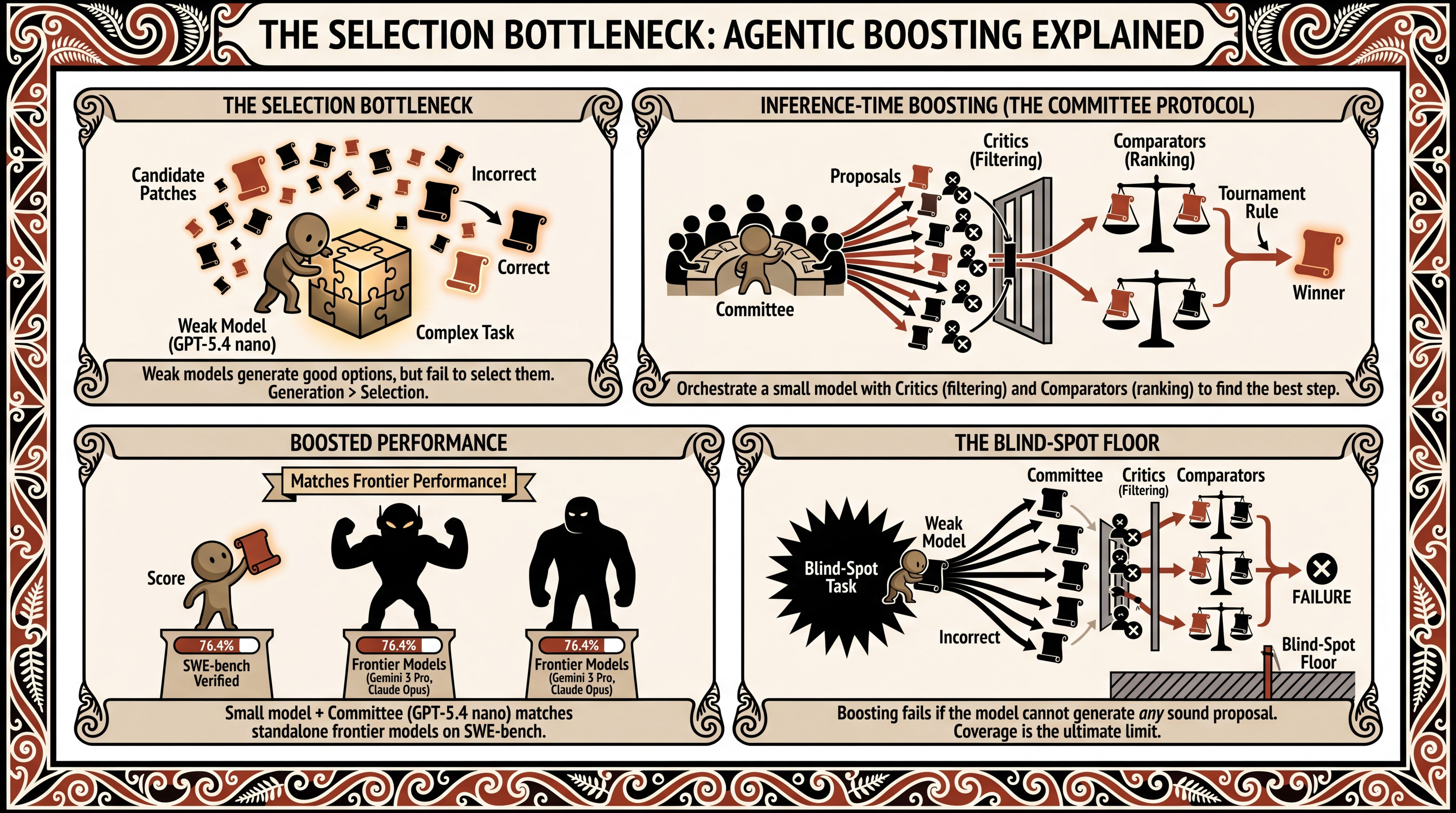
WHAT was done? The paper introduces a theoretical and empirical framework that formalizes agentic committee search as inference-time boosting. By dividing the problem into distinct components—proposal coverage, local identifiability, progress depth, and diversity—the authors show that a lightweight model (GPT-5.4 nano) can be orchestrated using a structured critic-comparator harness to match the standalone performance of frontier models on software engineering benchmarks.
WHY it matters? This matters because it shifts the focus of LLM scaling from monolithic parameter expansion to software-defined inference architectures. It mathematically proves that generation capability does not inherently imply verification capability, establishing that the ultimate limit of test-time scaling is bounded by the underlying proposer’s “blind-spot floor” rather than selection inefficiencies.
Details
The Scaling Bottleneck: From Generative Prolificacy to Selection Deficit
The current paradigm of artificial intelligence relies heavily on scaling model parameters to conquer complex, multi-step reasoning tasks. However, this brute-force approach ignores a fundamental characteristic of inference: weak models often generate correct reasoning steps or patches in their latent space that they simply fail to select. Previous inference-time scaling strategies, such as Self-Consistency or Large Language Monkeys, attempt to bypass this by repeatedly sampling the generator, relying on majority votes or flat reward models. The critical delta of this paper lies in demonstrating that simply generating more candidates is insufficient because raw coverage does not imply identifiability. Instead of treating selection as an afterthought, the authors model agentic workflows as sequential, verifier-backed search processes over partial states, establishing a rigorous mathematical separation between the generator’s ability to produce sound moves and the system’s ability to recognize them.
