
Alien Science: Sampling Coherent but Cognitively Unavailable Research Directions from Idea Atoms
Authors: Alejandro H. Artiles, Martin Weiss, Levin Brinkmann, Anirudh Goyal, and Nasim Rahaman
Paper: https://arxiv.org/abs/2603.01092
Code: https://anonymous.4open.science/r/Paper-atomyzer-82F4/
TL;DR
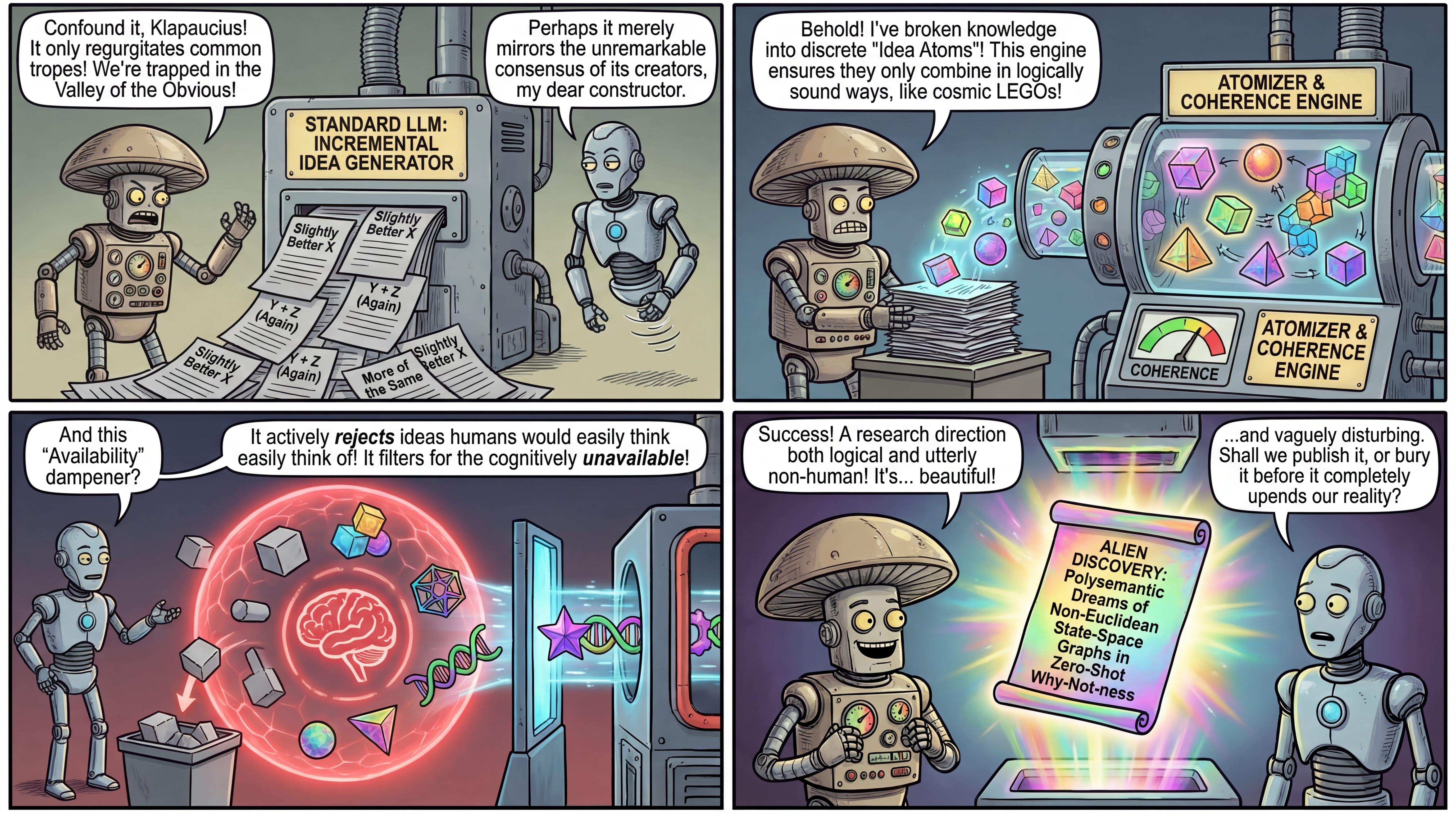
WHAT was done? The authors introduced a pipeline that decomposes thousands of machine learning papers into discrete “idea atoms,” then trains two generative models: one to maximize the structural coherence of atom combinations, and another to minimize their cognitive availability to typical researchers. By fusing these models, the system samples “alien” research directions that are logical but highly unlikely to be proposed by human scientists.
WHY it matters? Standard language models prompted to generate research ideas tend to output highly probable but incremental combinations, converging on a narrow slice of familiar concepts. By formally decoupling plausibility from human cognitive predictability, this framework allows researchers to deliberately explore the blind spots of the scientific community, shifting the role of AI from merely accelerating human ideation to complementing it with genuinely non-obvious trajectories.
The paper is published at the ICLR 2026 Post-AGI Science and Society Workshop.
Details
The Incremental Ideation Bottleneck
Scientific progress demands ideas that are both feasible and surprising. While modern language models excel at synthesizing familiar material, they struggle to generate research directions that the community would judge as genuinely non-obvious. When a model is trained to predict text drawn from the literature, its highest-likelihood outputs naturally follow the most heavily trafficked conceptual trajectories. Scaling up models does not intrinsically solve this bias; it merely makes the interpolation smoother. Naïve prompting of highly capable systems like Claude 4.5 Opus or Gemini 3 Pro to generate novel ideas typically results in a collapse into common tropes, combining currently fashionable topics rather than exploring the vast, valid space of unfamiliar combinations. To generate truly original directions, we need a mechanism that explicitly searches for viable ideas that human researchers are systematically unlikely to explore due to the limitations of localized expertise and disciplinary siloing.
