
Emergent Capabilities Arise Randomly from Learning Sparse Attention Patterns
Authors: Vatsal Baherwani, Zixi Chen, Shikai Qiu, Andrew Gordon Wilson, Pavel Izmailov
Paper: https://arxiv.org/abs/2606.25010
Code: N/A
Model: N/A
TL;DR
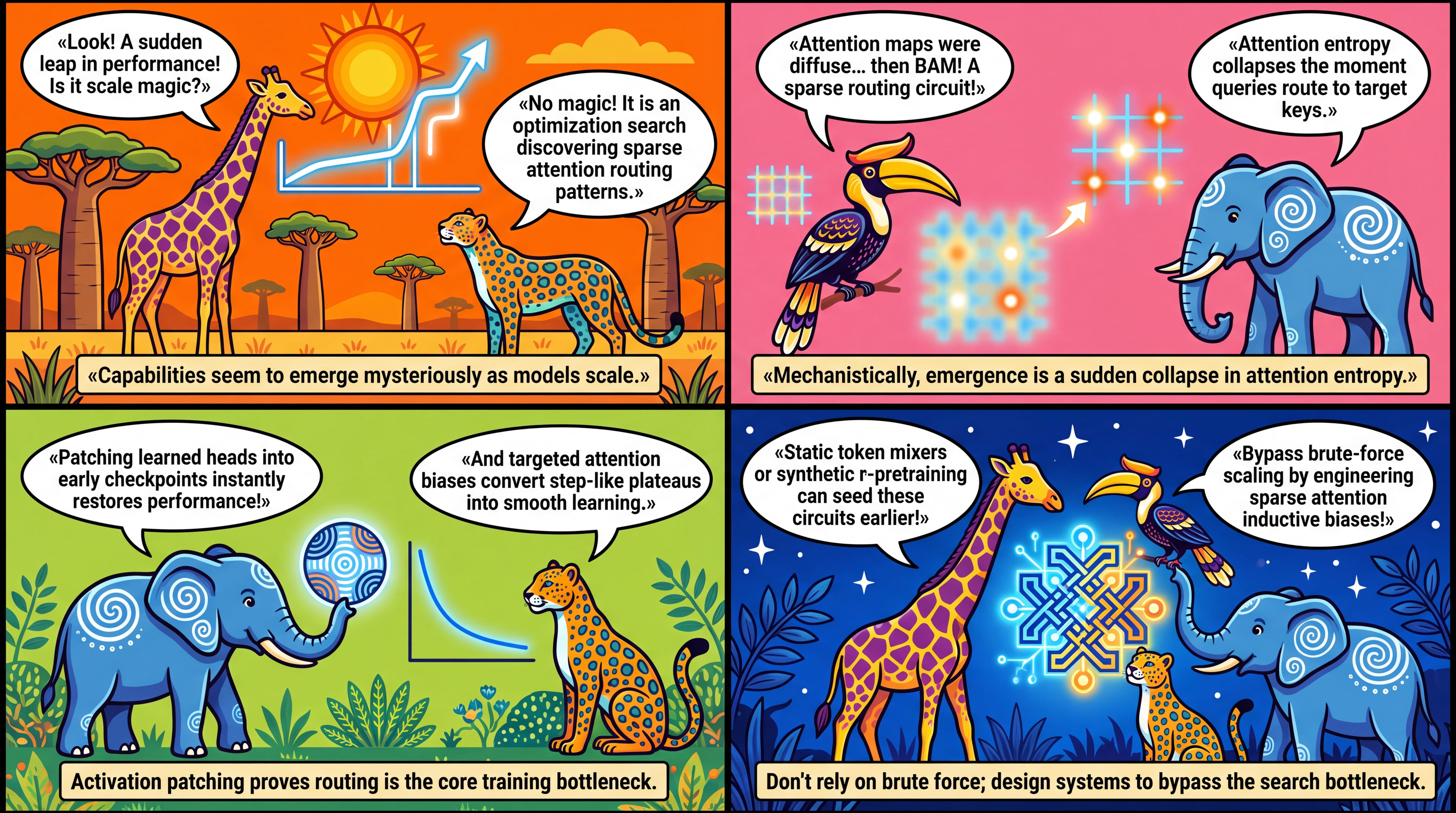
WHAT was done? The authors present a detailed mechanistic study showing that the sudden, stochastic acquisition of downstream capabilities during transformer training is driven by the abrupt discovery of task-relevant, sparse attention routing patterns. By analyzing pretrained LLMs and constructing controlled synthetic tasks, they isolate context length and pattern sparsity as the primary bottlenecks governing this learning process, while demonstrating that alternative architectures or pre-pretraining strategies can significantly accelerate emergence.
WHY it matters? This research de-mystifies “emergent capabilities” by shifting the paradigm from an inexplicable, scale-dependent phenomenon or a metric mirage into a concrete, optimization-driven search bottleneck. Understanding that emergence corresponds to the discovery of sparse routing circuits provides a clear path to bypass expensive brute-force scaling; instead, researchers can design architectures, targeted synthetic pre-pretraining pipelines, or optimization biases that make learning these sparse attention patterns highly sample-efficient.
Details
The Stochastic Search for Invisible Circuits
As transformer language models grow, they exhibit sudden leaps in downstream performance that can seem almost magical. However, a major conflict in contemporary AI research lies between the smooth, predictable improvements of global neural scaling laws and the abrupt, bimodal emergence of specific downstream capabilities at fixed scales. The authors of this work set out to address this gap by exploring what changes inside a model’s internal representation when a capability emerges. While prior work treats emergence either as a function of sheer scale or as an artifact of discontinuous evaluation metrics, this study shows that capabilities arise stochastically throughout training, with larger models simply discovering them earlier and more reliably. The core bottleneck is not the acquisition of complex semantic representations, but rather a simple optimization search challenge: the abrupt, high-variance discovery of sparse attention routing patterns that connect those representations.
