
Explorative Modeling: Unlocking a Third Pretraining Axis and End-to-End Generation
Authors: Alexi Gladstone, Heng Ji, Yilun Du
Paper: https://arxiv.org/abs/2607.27372
Code: https://github.com/alexiglad/XM
Site: https://explorative-modeling.github.io/
Model: N/A
TL;DR
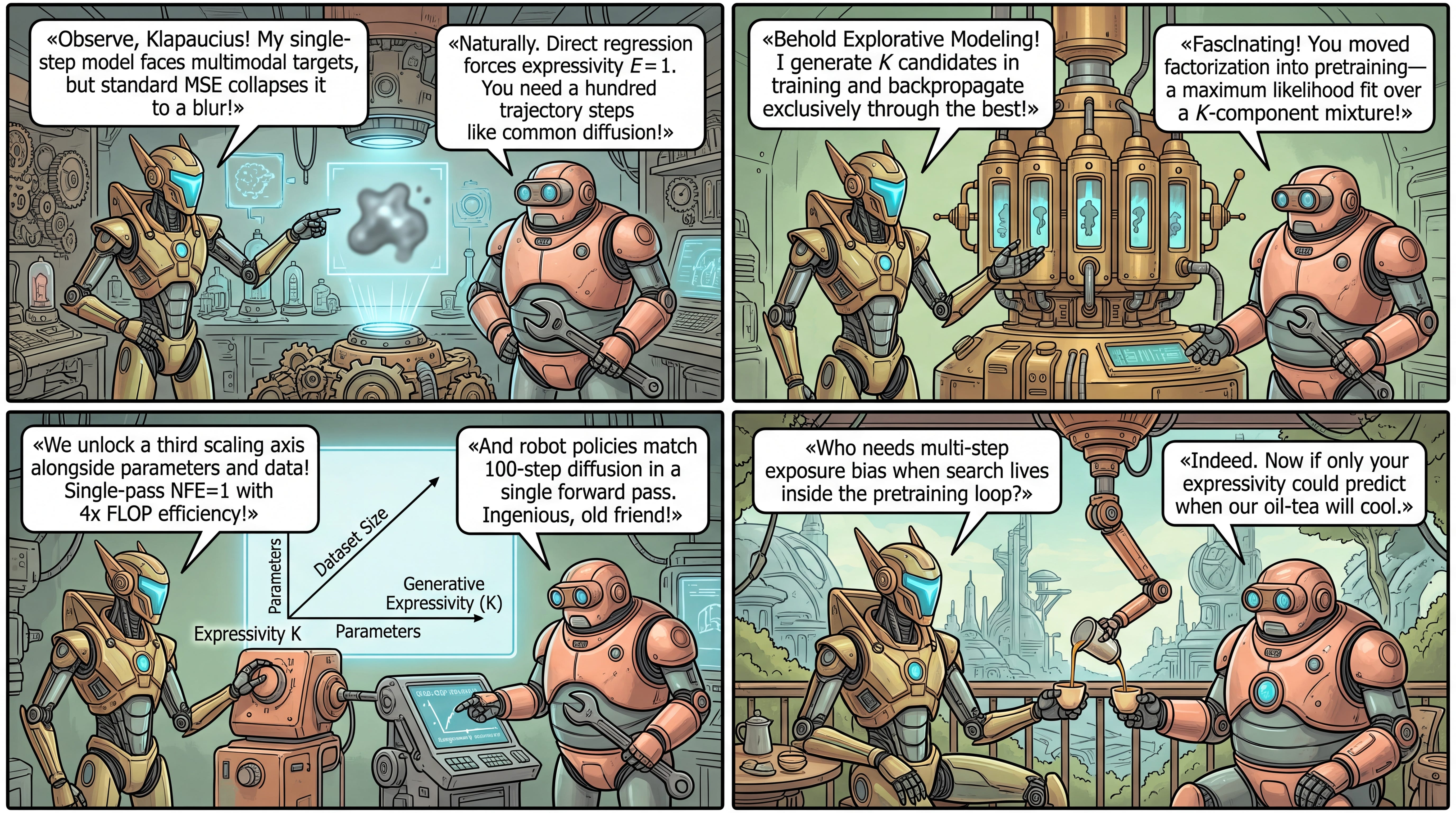
WHAT was done? The authors introduce Explorative Modeling (XMs), a generative pretraining paradigm that shifts factorization from the generation process to the training loop. By generating K candidate outputs (or evaluating against K data samples) per training step and backpropagating gradients exclusively through the best match, XMs prevent mode blurring, increase generative expressivity, and enable single-pass end-to-end generation.
WHY it matters? Traditional reconstructive generative models rely on multi-step trajectory factorization during inference to handle multimodal data, introducing compounding errors and severe exposure bias. Explorative Modeling establishes generative expressivity as a missing third pretraining axis alongside parameter count and dataset size. It achieves a near-state-of-the-art 1.43 unguided FID on ImageNet 256x256 while improving FLOP efficiency by 4.1x, sample efficiency by 6.2x, and parameter efficiency by 47%. In robotics and world modeling, XMs match standard diffusion performance using 16x to 256x fewer inference steps.
Executive summary: Modern generative architectures solve multimodal probability modeling by breaking inference into hundreds of sequential steps. This multi-step sampling creates a fundamental train-inference mismatch and severe computational overhead at runtime. Explorative Modeling replaces multi-step generation with search inside the training loop. By allowing model predictions to commit to individual modes via a best-of-K candidate match during pretraining, inference can be collapsed to a single forward pass without sacrificing mode coverage. Crucially, the efficiency gains of exploration do not saturate—they expand as model scale and data volume grow, offering a new compute-optimal scaling dimension for foundation models.
Details
The Multimodal Bottleneck in Generation Factorization
The historical trajectory of deep learning is defined by replacing hand-crafted, multi-stage pipelines with unified end-to-end optimization. Image classification, object detection, and semantic segmentation all advanced when networks were trained to perform inference under the exact same conditions as training. Generative modeling, however, has remained a notable exception. Standard reconstructive approaches, including flow matching, diffusion models like SiT and DiT, and autoregressive sequence models, are not trained end-to-end. At inference, they operate as recurrent models unrolled over dozens or hundreds of steps. Each step introduces small prediction errors that accumulate over the generation trajectory, causing inputs to drift off the training distribution—a failure mode widely recognized as exposure bias.
This architectural compromise exists because generative modeling requires learning multimodal probability distributions. When a single latent or input context maps to multiple valid data targets across a dataset, standard single-step regression loss functions force the model to predict the expected value across those targets. In continuous spaces, this expected value lands in low-density regions off the data manifold, manifesting as blurry images or incoherent trajectories. To prevent this mode blurring, current scalable models factor the generation procedure into fine-grained sequence steps, ensuring that each individual step faces a nearly unimodal target conditional. While this generation factorization yields high sample quality, it locks models into multi-step inference and creates an insurmountable train-inference gap. Explorative Modeling re-examines this fundamental tradeoff by asking whether factorization can be moved out of the generation procedure and directly into the pretraining loop.
