
Hilbert Operator for Progressive Encoding (HOPE): A Mathematical Framework for Deconstructing Learned Representations in Deep Networks
Authors: Hossein Mobahi, Peter L. Bartlett / Google DeepMind, Berkeley
Paper: https://arxiv.org/abs/2607.21366v1
Code: N/A
Model: N/A
TL;DR
WHAT was done? The authors introduce HOPE, a mathematical framework that analyzes and compresses neural networks by translating them from discrete lists of weights into continuous mathematical functions. By combining this perspective with a data-free statistical technique, the framework can prune, merge, and delete entire layers of a network without requiring a single pass of training data.
WHY it matters? Standard methods for compressing or interpreting models often rely on the raw size of a network’s parameters, which can be mathematically misleading, or on feeding real data through the model, which is computationally expensive and prone to privacy issues. By moving the analysis strictly into the realm of function space, this work offers a rigorous, automated way to shrink models and protect their foundational knowledge when learning new tasks.
Details
The Illusion of the Dials
Deep neural networks are fundamentally opaque, defined by billions of physical parameters—the individual weights and biases that dictate how signals flow from input to output. When researchers want to compress a model to make it run faster, or peek inside to see what it has actually learned, they typically rely on two approaches.
The first is to run thousands of images or text snippets through the network and meticulously track which neurons fire. This is accurate but computationally grueling, and the results are often brittle, heavily biased by the specific data samples chosen. The second, much faster approach is magnitude pruning: simply looking at the raw parameters and deleting the ones closest to zero.
But judging a neural network by its parameter magnitudes is a lot like judging a book by weighing its ink. Neural networks are riddled with “scale symmetries.” If you multiply an incoming signal by ten, but simultaneously divide the outgoing signal by ten, the final output remains perfectly unchanged. The network is doing the exact same job, but the raw numbers inside look drastically different. A crucial feature might be hiding behind numerically small parameters, while optimization artifacts masquerade as massive, “important” weights.
To escape this parameter illusion, Hossein Mobahi and Peter L. Bartlett from Google DeepMind and UC Berkeley propose a framework called HOPE (Hilbert Operator for Progressive Encoding). Their premise is simple: to understand what a network is doing, we must stop looking at the physical dials and start looking at the actual shape of the transformation the network applies to the data.
Moving into Function Space
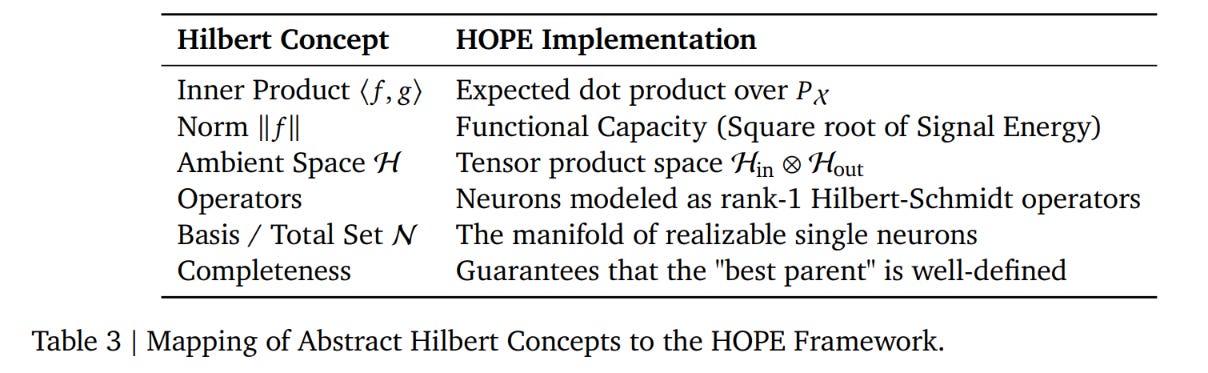
To accomplish this, HOPE completely abandons the discrete parameter space. Instead, it lifts the network into a continuous mathematical arena known as a Hilbert space.
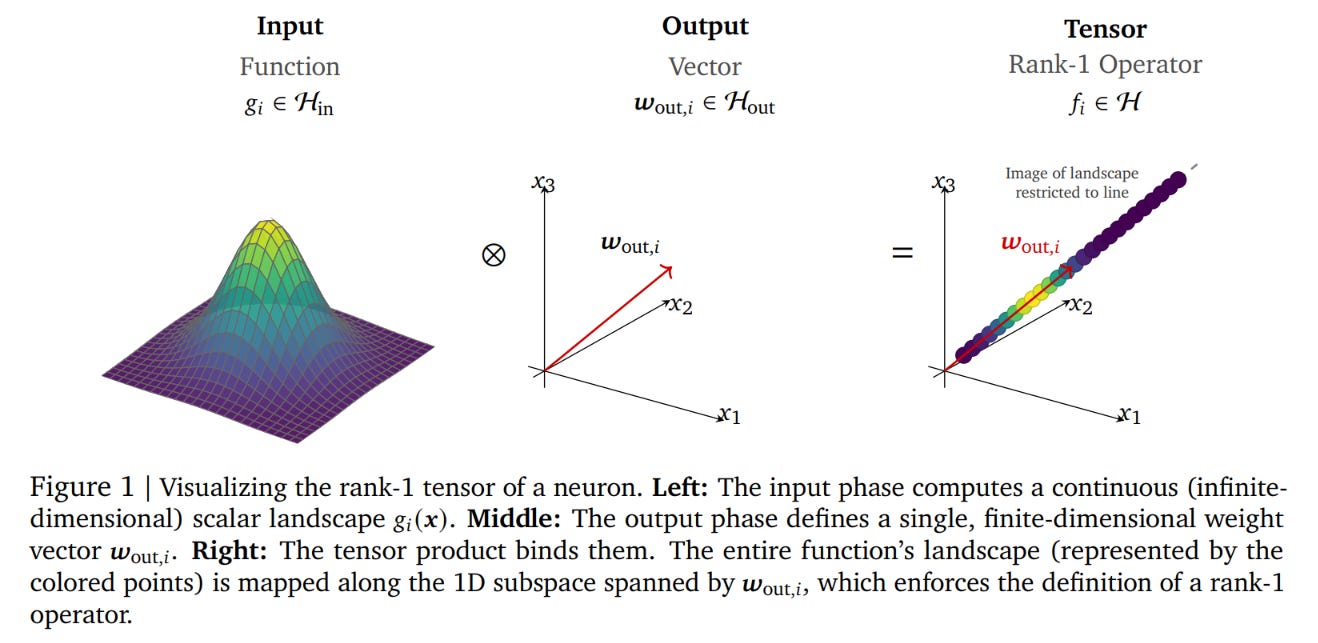
Term Spotlight: Rank-1 Hilbert-Schmidt Operator In functional analysis, this refers to an operator acting on a Hilbert space that can be expressed as the outer product of two elements, having a finite Hilbert-Schmidt norm. For machine learning researchers, this translates to a weight matrix formed by multiplying a single column vector by a single row vector. In HOPE, this concept is used to represent a neuron’s entire end-to-end action: it takes a continuous, infinite-dimensional input landscape (the row) and broadcasts it out along a specific, finite-dimensional direction to the next layer (the column).
In this framework, a single neuron is no longer a localized list of numbers. As visualized in Figure 1 of the paper, it is modeled as a continuous, geometric surface. Once the network is translated into this continuous geometry, the framework evaluates the "functional capacity" of each neuron—essentially, the physical energy of the signal it produces.
But evaluating this energy poses a catch-22: how do you measure the shape of a function without passing real data through it?
The authors solve this using the Maximum Entropy principle. Modern neural networks almost universally use Batch Normalization, a technique that stabilizes training by tracking the average mean and variance of signals passing through each layer. HOPE extracts these stored statistics directly from the trained model’s checkpoint. It then constructs a synthetic surrogate dataset—a continuous Gaussian distribution—that perfectly matches those statistics. Because this ghost dataset is a pure mathematical distribution, HOPE can calculate the exact functional energy of every neuron analytically, using closed-form equations, without a single real image or forward pass.
The Geometry of Cleanup
Once the network’s energy is mapped out over this surrogate data, HOPE begins compressing it. Because everything is now represented in a unified geometric space, the framework can perform three very different physical operations using the exact same mathematical ruler: distortion cost.
If a neuron has very little functional capacity, HOPE prunes it, which geometrically means projecting its surface down to zero. If two neurons are doing almost the exact same thing—a common redundancy in over-parameterized networks—HOPE merges them. It calculates a new, single “parent” surface by finding the closest directional fit that minimizes the geometric distance to the two original child surfaces, synthesizing one neuron to do the work of two. Finally, HOPE can evaluate entire residual pathways. If a macroscopic block of layers is contributing negligibly to the overall function, HOPE evicts it, replacing the entire block with a simple identity connection.
The system operates as a greedy loop: it continually scans the network, calculates the distortion cost of every possible prune, merge, or eviction, executes the most efficient action, and repeats.
Preserving Memory in New Domains
The authors deployed HOPE to tackle a notoriously difficult problem in AI: catastrophic forgetting. When a neural network is fine-tuned to learn a new task, it tends to aggressively overwrite the weights that encoded its previous knowledge.
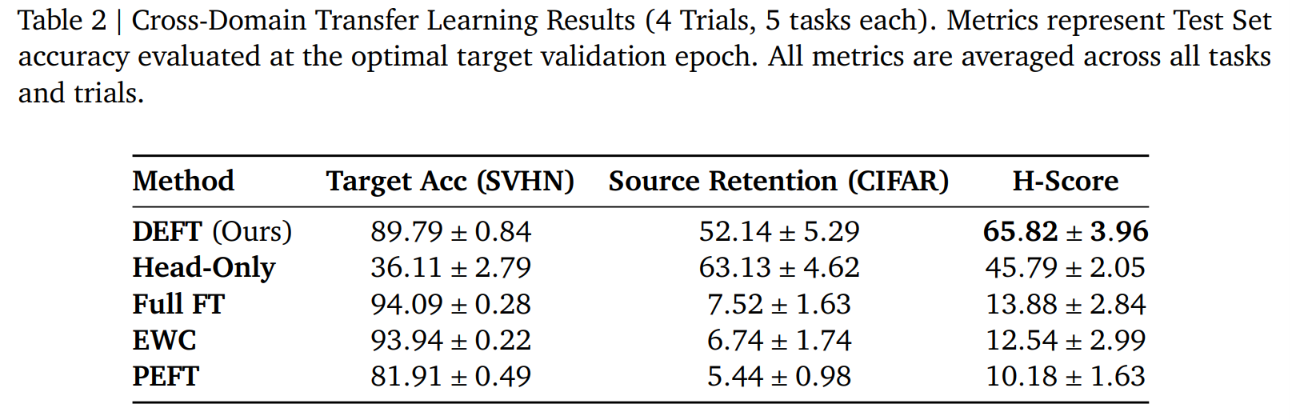
To test this, the researchers took a vision model trained to recognize everyday objects (a subset of the CIFAR-100 dataset) and asked it to learn to read street numbers (the SVHN dataset). When using standard fine-tuning, the model successfully learned to read house numbers, hitting 94.09% accuracy. However, its memory of the original objects was obliterated, plummeting to just 7.52% accuracy.
Even specialized techniques designed to prevent forgetting struggle here. For instance, Elastic Weight Consolidation (EWC), a classic method that penalizes changes to “important” weights, still resulted in the model retaining only 6.74% of its source knowledge.
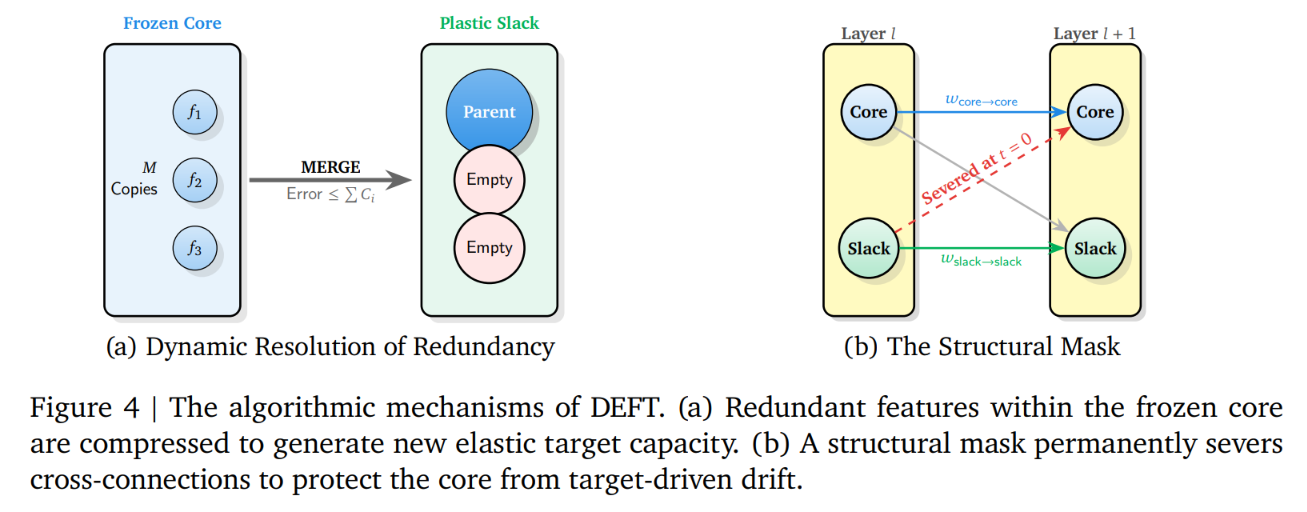
The authors introduced a new algorithm built on their framework, called Dispersed Elastic Fine-Tuning (DEFT). DEFT uses HOPE to evaluate the functional capacity of every neuron. Neurons with high capacity are designated as the “Universal Core” and strictly frozen to protect foundational knowledge. Neurons with low capacity are designated as “Plastic Slack” and allowed to learn the new task.
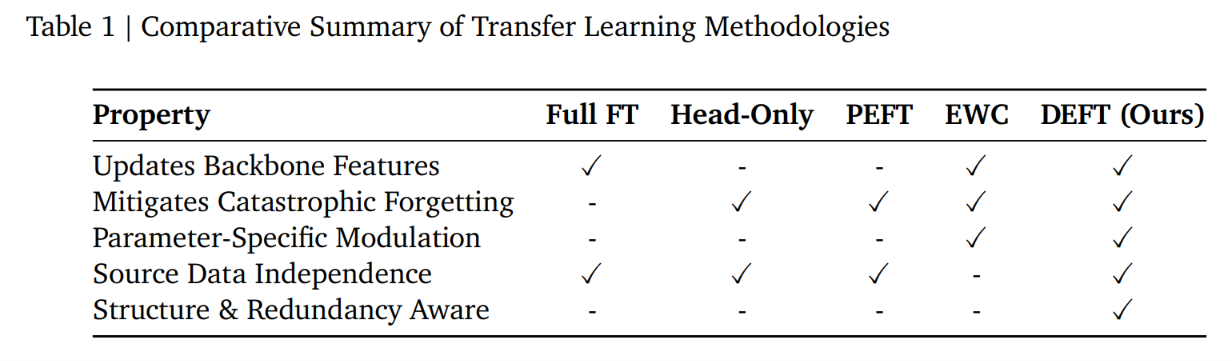
Crucially, as shown in Figure 4, DEFT actively hunts for redundant features in the core and merges them. This preserves the original feature while freeing up the redundant neuron, migrating it into the slack space to give the network more room to learn. Finally, DEFT applies a structural mask to ensure the changing signals in the slack space do not bleed into and corrupt the frozen core.
The results, detailed in Table 2, show a stark contrast to previous methods. DEFT achieved 89.79% accuracy on the new house numbers task, while simultaneously retaining 52.14% accuracy on the original object recognition task. This balance yielded an overall H-Score (a metric balancing new learning and old retention) of 65.82, a significant improvement over the best competing baseline, which managed an H-Score of only 45.79.
Caveats and Context
While the theoretical grounding is rigorous, the authors are careful to frame their experiments as proof-of-concept validations rather than exhaustive, large-scale benchmarks. The framework has a few notable constraints. First, the elegant, data-free mathematical integration relies specifically on the properties of piecewise-linear activation functions (like the ubiquitous ReLU). Adapting it to the smooth activations favored in modern Large Language Models would require new analytical derivations.
Furthermore, the data-free nature of the framework depends entirely on the presence of Batch Normalization layers to provide the statistical anchors. If a network uses a different normalization scheme, or no normalization at all, HOPE requires a brief calibration pass with a small batch of real data to capture the necessary statistics before it can operate. Finally, computing the exact interaction between every single pair of neurons for potential merging scales quadratically, which forced the authors to use a zero-bias approximation to keep the algorithm fast on large networks.
The Verdict
HOPE represents a necessary maturation in how we analyze neural networks. By proving that we can evaluate, merge, and compress network architectures strictly through the lens of continuous function spaces—and do so without the computational anchor of empirical data passes—this paper bridges a gap between abstract functional analysis and practical model compression. It demonstrates that when we stop being fooled by the arbitrary scales of individual parameters, we can manipulate deep networks using a rigorous mathematical approach rather than relying on parameter-based heuristics.