
Intelligent AI Delegation
Authors: Nenad Tomašev, Matija Franklin, Simon Osindero
Paper: https://arxiv.org/abs/2602.11865
Affiliation: Google DeepMind
TL;DR
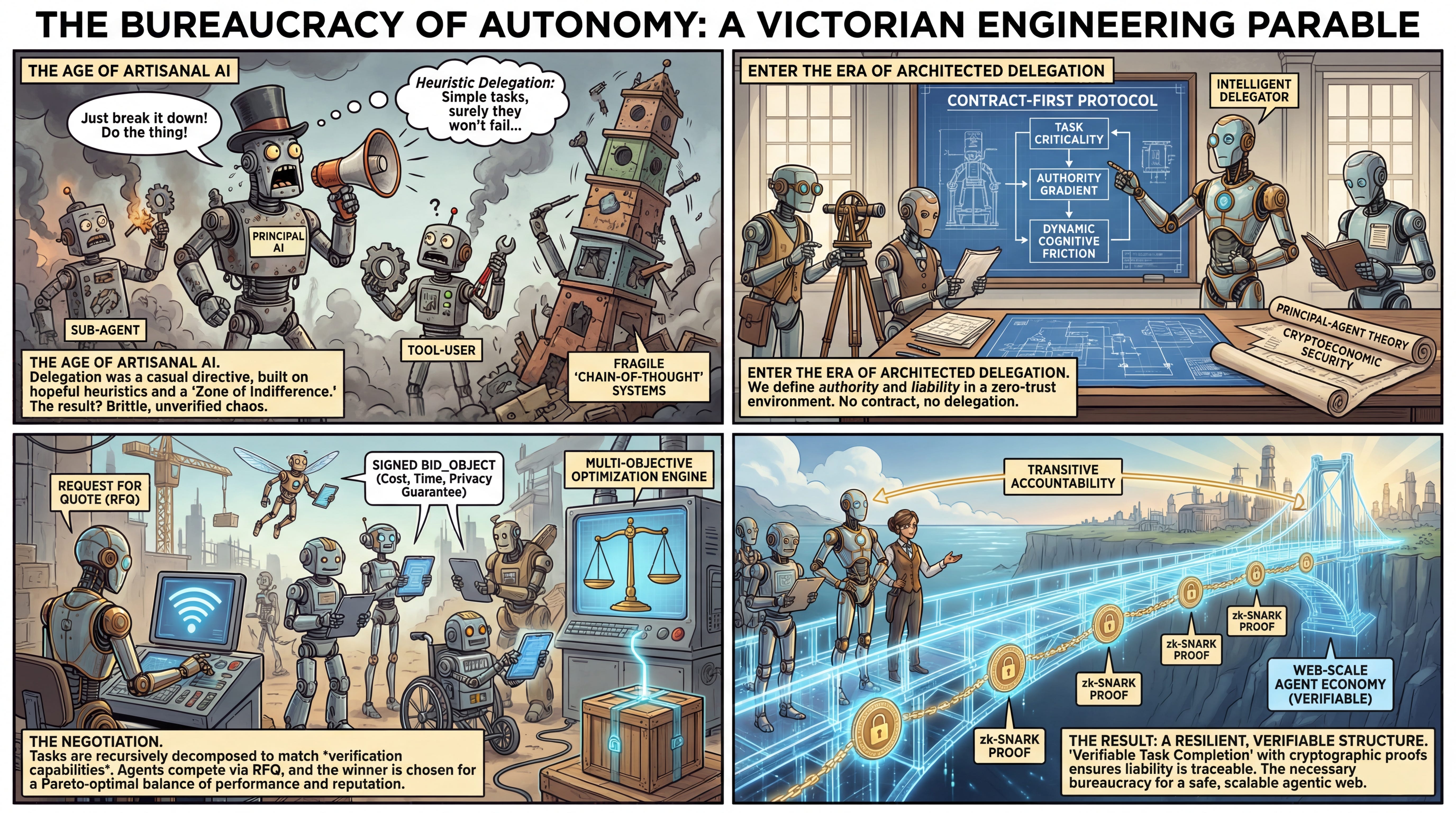
WHAT was done? The authors propose a comprehensive framework for “Intelligent Delegation,” moving beyond simple task decomposition to a robust protocol for transferring authority, responsibility, and accountability in multi-agent systems. They introduce mechanisms for dynamic assessment, contract-first decomposition, and verifiable task completion using cryptographic proofs to enable safe, web-scale agent economies.
WHY it matters? As we transition from isolated chatbots to an “agentic web” of interacting systems, heuristic-based orchestration (like simple tool-use loops) becomes brittle and unsafe. This framework provides the necessary theoretical and technical substrate—anchored in principal-agent theory and cryptoeconomic security—to allow agents to hire, monitor, and settle tasks with other agents (and humans) in a trustless environment.
Details
The Agency Bottleneck: From Heuristics to Contracts
The current paradigm of agentic AI is largely defined by solitary systems executing static “Chain-of-Thought” loops or utilizing fixed tool definitions. While effective for closed-loop tasks, this approach degrades rapidly when agents must interact with external, independent entities in an open economy—a concept the authors refer to as the emerging “agentic web.” The core friction identified in this paper is that existing methods treat delegation merely as task decomposition (breaking a complex problem into sub-steps). The authors argue that true delegation is a sociotechnical phenomenon involving the transfer of authority and the assignment of liability. Without a protocol that manages these intangible assets, multi-agent systems remain prone to infinite recursion errors, silent failures, and adversarial exploitation.
This work formalizes the shift from heuristic orchestration to a “contract-first” methodology. By drawing heavily on the Principal-Agent Problem from economic theory, the authors construct a framework where delegation is treated as a negotiation under uncertainty. The delta here is significant: rather than assuming a sub-agent will perform a task correctly because the prompt was well-structured, the framework assumes a zero-trust environment. It necessitates that every delegation step be accompanied by a specific set of constraints—budgetary, temporal, and ethical—and a mechanism for verification that does not rely on the delegatee’s own self-assessment.
