
Authors: Ryan Burnell, Yumeya Yamamori, Orhan Firat, Kate Olszewska, Steph Hughes-Fitt, Oran Kelly, Isaac R. Galatzer-Levy, Meredith Ringel Morris, Allan Dafoe, Alison M. Snyder, Noah D. Goodman, Matthew Botvinick, and Shane Legg
Paper: https://arxiv.org/abs/2605.28405
Code: N/A
Model: N/A
TL;DR
WHAT was done? The paper introduces a scientifically grounded evaluation framework for Artificial General Intelligence (AGI) based on human cognitive psychology. It deconstructs general intelligence into a Cognitive Taxonomy of ten distinct faculties (eight basic and two composite) and details a three-stage evaluation protocol to construct multidimensional, system-level “cognitive profiles” mapped against demographically representative human baselines.
WHY it matters? Current AI evaluation is plagued by public benchmark contamination, a narrow focus on specialized academic tasks, and subjective definitions of intelligence. By shifting the measurement of AGI from binary, model-centric thresholds to continuous, system-level cognitive mapping, this framework provides researchers and policymakers with a rigorous, empirical methodology to identify safety vulnerabilities, track true progress, and support informed governance.
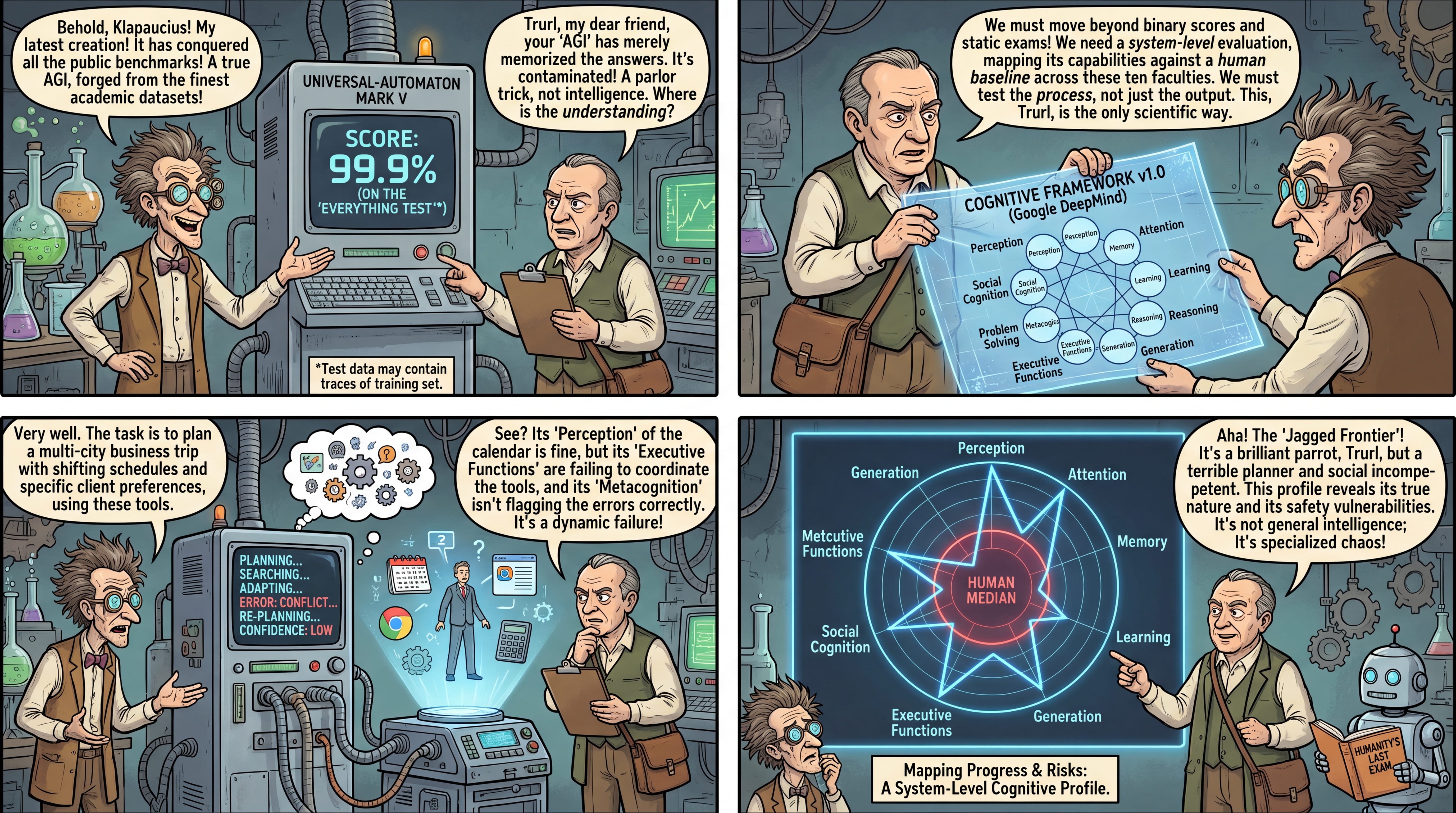
Executive Summary: For leaders, policymakers, and non-technical stakeholders, this paper marks a transition from evaluating AI using static, easily contaminated academic exams to testing AI as dynamic, integrated systems. Instead of declaring a model as “AGI” based on a single score, this framework evaluates how well an AI system (including its tools and scaffolding) performs across ten core human cognitive dimensions, such as planning, learning, and social interaction, compared directly to a representative human population. This allows decision-makers to identify specific behavioral risks and plan deployment strategies based on structured, empirical safety profiles rather than speculative hype.
Details
The Evaluation Crisis: Navigating the Speculative Landscape of AGI
Our current methods for evaluating frontier artificial intelligence are fundamentally broken. While capabilities are escalating rapidly, our benchmarks remain fragmented, highly susceptible to data contamination, and deeply disconnected from the reality of how these models are deployed in the real world. Many of the most popular evaluation datasets are public, meaning their contents inevitably leak into training corpora, rendering subsequent testing invalid. Furthermore, existing benchmarks focus heavily on academic knowledge retrieval while leaving massive blind spots in critical, human-like capacities such as metacognition, attention, online learning, and social coordination. To address these vulnerabilities, this work proposes a major paradigm shift, moving away from single-score leaderboards toward a robust, multi-dimensional, and scientifically grounded methodology. This new framework builds upon conceptual precursors like the Levels of AGI framework and Francois Chollet’s work on cognitive generalization in On the Measure of Intelligence. The core objective is to replace speculative, hype-driven claims about general intelligence with systematic, behavioral measurements mapped directly to the established science of human cognition.
Marr’s Legacy: A Mechanism-Agnostic Cognitive Taxonomy
The theoretical foundation of this evaluation framework is rooted in David Marr’s classic levels of analysis, prioritizing the computational level over the algorithmic or physical levels. By focusing strictly on what a system is able to accomplish rather than how it accomplishes it, the framework remains entirely agnostic to internal neural architectures, training algorithms, or physical hardware configurations. The authors partition general intelligence into ten distinct cognitive faculties, which are visualized in Figure 1.
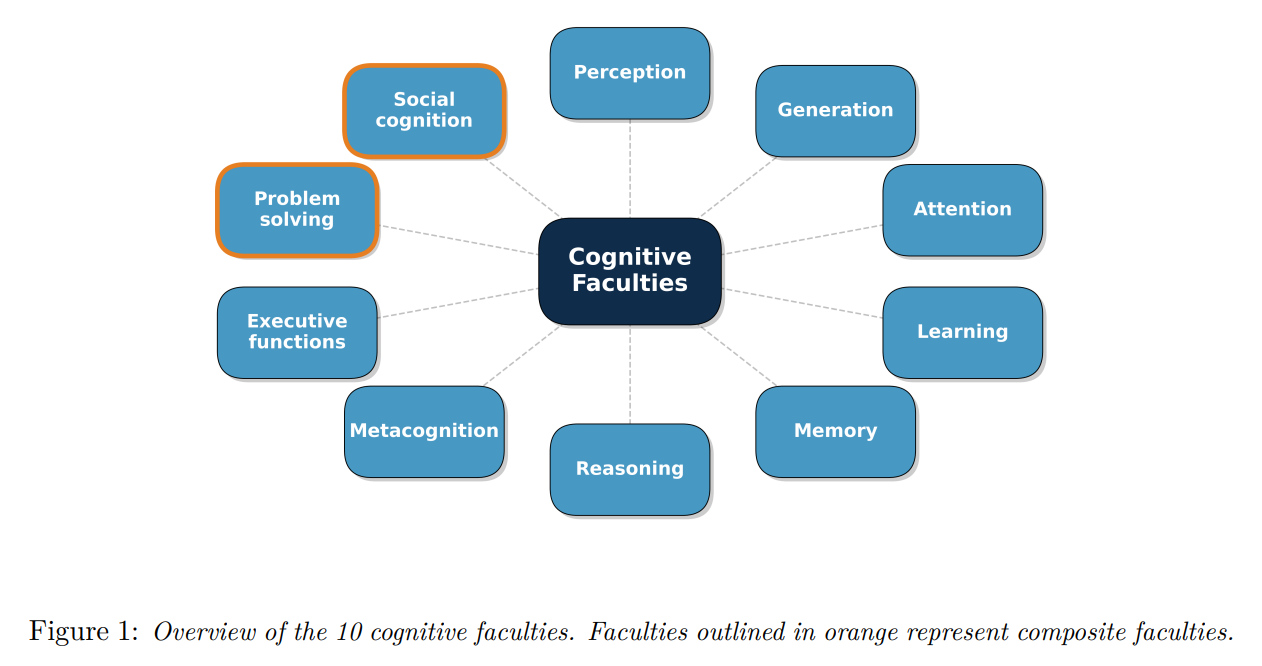
The first eight faculties represent the atomic building blocks of human cognition. These comprise Perception, the extraction of sensory information; Generation, the execution of speech, text, or motor control; Attention, the selective allocation of cognitive resources; Learning, the online acquisition of new skills or concepts; Memory, the maintenance and retrieval of semantic and episodic knowledge; Reasoning, the derivation of logical conclusions; Metacognition, a system’s self-knowledge and control of its own cognitive processes; and Executive Functions, which orchestrate goal-directed behaviors through planning, inhibition, and cognitive flexibility. To capture how these processes coordinate under real-world conditions, the authors introduce two composite faculties: Problem Solving, which demands the integration of planning, reasoning, and in-context adaptation, and Social Cognition, which includes social perception, theory of mind, and cooperation.
A Walkthrough of System-Level Evaluation
To illustrate the operational flow of this framework, we can follow a single, unified agent through the evaluation protocol. Consider an AI agent equipped with web-search tools, a code interpreter, and custom system-level wrappers, which is tasked with coordinating a highly complex travel itinerary while managing real-time schedule changes and client preferences. This task cannot be solved by a static model checkpoint; it must be evaluated as a unified system. First, the agent receives multi-modal inputs, requiring visual and textual Perception to parse calendar data, combined with Attention to ignore irrelevant filler emails. The agent must utilize its Memory to recall company travel policies while using online Learning to adapt to a novel booking API. As unexpected flight cancellations occur, the agent’s Executive Functions are tested through dynamic planning and cognitive flexibility, building out decision-tree paths to resolve the conflict. If the system fails to correct a booking error, its Metacognition is assessed based on whether it calibrates its confidence score and flags the failure for human review. To quantify this performance, we use Item-Response Theory (IRT) to estimate the system’s latent ability. If we denote the latent ability of system i on a specific cognitive faculty f as θif, the probability of successfully solving task item j within that faculty is modeled via a logistic link:
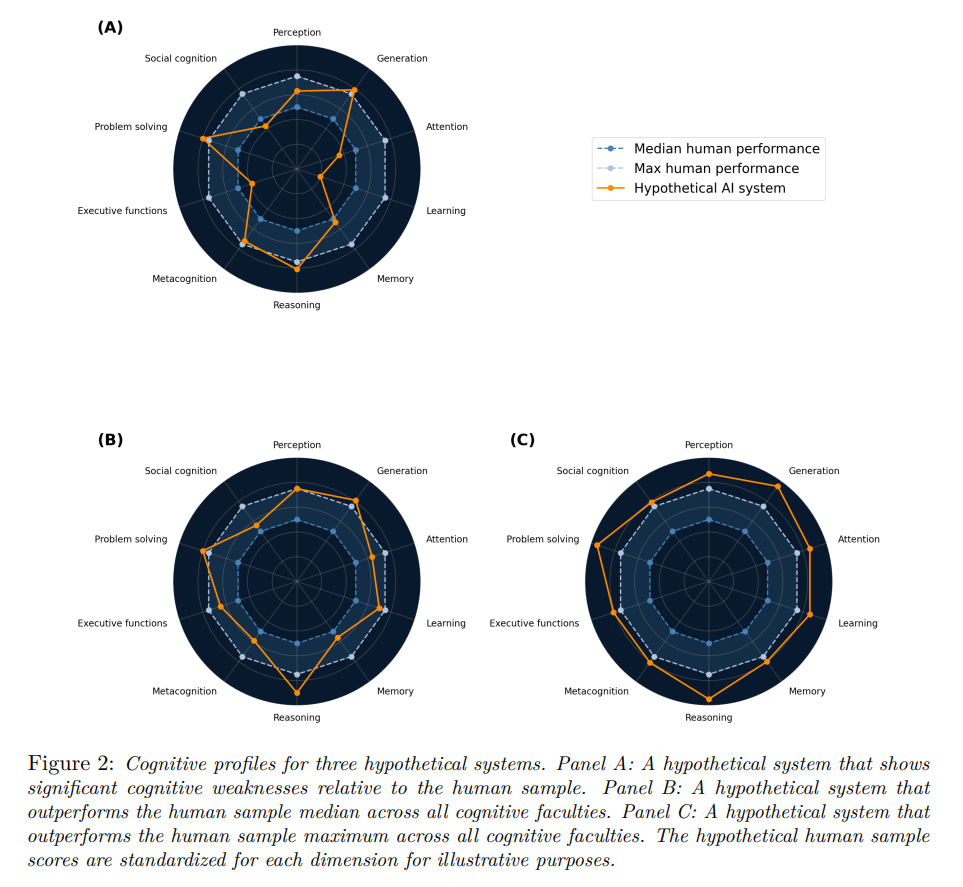
where Yij is the binary correctness of the response, and bj represents the calibrated difficulty parameter of the task item. This latent ability estimate θif is then mapped onto a standardized distribution of performance data collected from a demographically representative sample of adult humans. The final output is a multidimensional radar chart, or “cognitive profile,” depicting the exact percentage of the human population the AI system outperforms across each of the ten faculties, as shown in Figure 2.
Addressing the Real-World Complications of System-Level Testing
Measuring intelligence at the system level rather than the model checkpoint level introduces significant engineering and methodological challenges. Historically, evaluations were performed on raw checkpoints to isolate the model’s intrinsic capabilities. However, modern AI applications rely heavily on prompt scaffolding, multi-agent coordination, and external tool integration. The authors argue that evaluating the model in isolation is becoming increasingly impractical and unrepresentative of actual system behavior. Yet, allowing systems to utilize external tools during testing can easily muddy the interpretation of individual cognitive faculties. For example, if an agent is permitted to query the web during a memory evaluation, the test ceases to measure the system’s internal semantic memory and instead measures its search capabilities. To resolve this, the framework demands strict control over the experimental environment. For any given cognitive task, if the AI system is granted access to tools such as calculators or web search, the human baseline sample must be given identical access under the same instructions. Furthermore, the stochasticity of generative systems introduces substantial variance across test iterations. The authors emphasize that characterizing this uncertainty through repeated trials, prompt variations, and confidence intervals is absolutely critical for establishing whether differences between systems, or between a system and a human baseline, are statistically meaningful.
Analysis of Jagged Frontiers and Human Distributions
The primary diagnostic value of the cognitive profile lies in its ability to map the “jagged frontier” of AI capabilities. Unlike humans, whose cognitive abilities tend to be relatively balanced due to evolutionary and developmental constraints, AI systems frequently exhibit extreme discrepancies across different domains. In Figure 2, Panel A depicts a hypothetical system that outperforms the human median in perception, generation, and reasoning, but falls catastrophically short in metacognition and executive planning. Such a system would appear highly capable in conversational settings but would fail unpredictably if deployed in autonomous, long-horizon workflows. Panel B illustrates a system that has successfully crossed the human baseline sample median across all ten faculties, representing a robust level of general capability. Panel C showcases a highly advanced system that surpasses the maximum performance of the human sample across every single cognitive dimension. This structured visualization prevents developers from overhyping a model’s capabilities based on narrow academic exam successes, such as those evaluated in Humanity’s Last Exam, while simultaneously preventing the underestimation of its specialized strengths.
Roots in Prior Work and the Path to Standardization
This framework represents a synthesis of decades of research in psychology, neuroscience, and artificial intelligence evaluation. It directly extends the taxonomy of cognitive stages outlined in Levels of AGI, but operationalizes it by introducing a concrete, multi-stage evaluation protocol. It shares a common philosophy with Chollet’s On the Measure of Intelligence and ARC-AGI-2 by arguing that intelligence must be evaluated through a system’s capacity to acquire new skills under resource constraints rather than its static database of pre-trained facts. To address the factuality and knowledge retrieval gaps highlighted by benchmarks like SimpleQA, the authors’ taxonomy explicitly integrates semantic and episodic memory as core measurable dimensions. Finally, the framework connects with emerging methodologies for studying AI behavior and alignment, such as Evaluating Alignment and Capabilities Ain’t All You Need, recognizing that safety cannot be assessed without understanding the system’s behavioral propensities alongside its raw capabilities.
Critical Gaps and Strategic Weaknesses of the Proposal
While the theoretical architecture of the framework is exceptionally robust, its practical execution faces major bottlenecks. First, the paper is primarily a conceptual and positional piece; it does not introduce any new empirical datasets, benchmark software, or physical evaluations of existing frontier models. The authors openly acknowledge that they are still working with the academic community to design and secure the necessary held-out evaluations. Developing high-quality, private, and contamination-free tests for complex domains like social cognition and metacognition is an open research problem. Second, recruiting and testing a demographically representative human sample of sufficient size to establish reliable baseline distributions across all ten faculties is a highly complex and expensive undertaking. Third, the taxonomy assumes that human cognitive architecture is the ideal reference point for general intelligence. This anthropocentric assumption risks mischaracterizing or completely ignoring emergent, non-human cognitive capabilities, such as LiDAR perception or high-dimensional native data processing, which have no direct human analog.

Shifting the Paradigm of AGI Safety and Governance
Ultimately, this paper is a highly professional call to action that could fundamentally redefine how the AI community conceptualizes and tracks progress toward AGI. By providing a structured, multidimensional vocabulary and a robust statistical methodology, the authors offer a viable path away from subjective, sensationalist claims toward a measurable, empirical science. For policymakers and safety researchers, this framework provides a highly actionable roadmap. Instead of relying on arbitrary compute thresholds or simple academic exam scores to trigger safety regulations, governance frameworks can be anchored to concrete system-level cognitive profiles. This ensures that safety interventions are proportional, targeting specific system vulnerabilities in areas like planning, social deception, and tool coordination before systems are deployed in high-risk, real-world environments.