Authors: Yinjie Wang, Xuyang Chen, Xiaolong Jin, Mengdi Wang, Ling Yang
Paper: https://arxiv.org/abs/2603.10165
Code: https://github.com/Gen-Verse/OpenClaw-RL
TL;DR
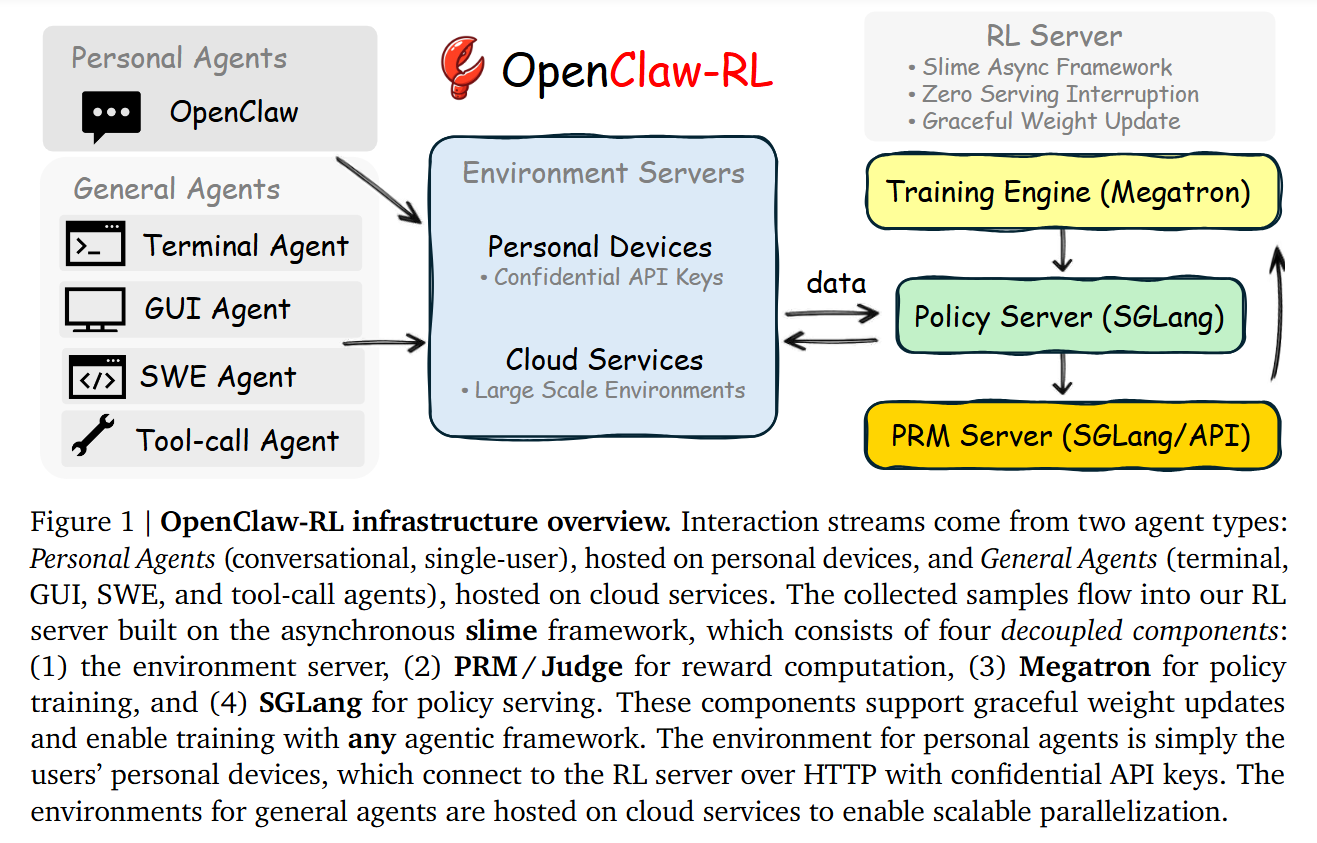
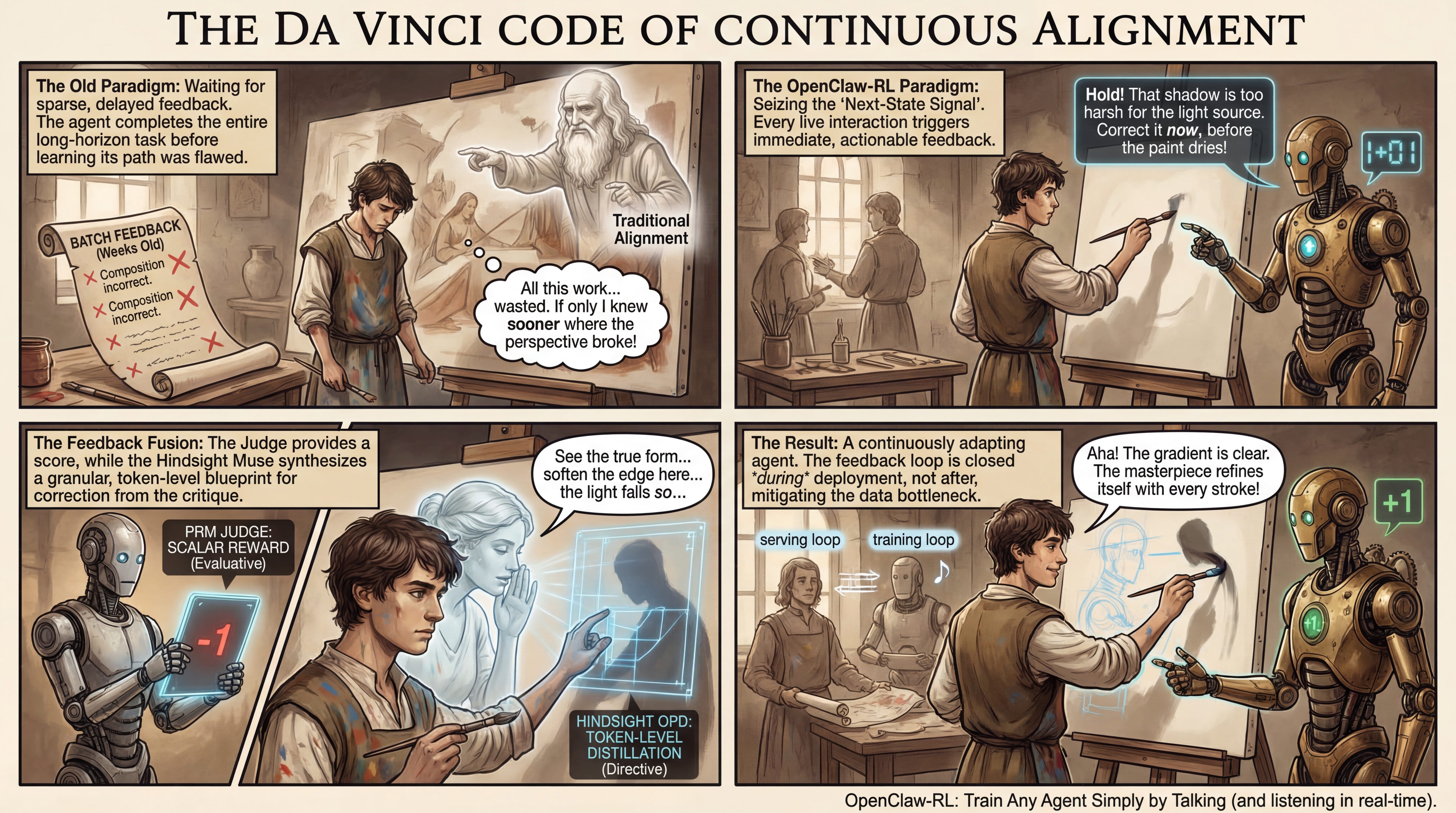
WHAT was done? Researchers from Princeton University introduced OpenClaw-RL, an asynchronous reinforcement learning framework designed to train language agents continuously during live deployment. By decoupling policy serving, environment execution, reward judging, and model training into independent asynchronous loops, the system captures ephemeral “next-state signals” (such as user corrections or terminal trace errors) and converts them into optimization gradients using a combination of scalar Process Reward Models (PRMs) and token-level Hindsight-Guided On-Policy Distillation (OPD).
WHY it matters? The prevailing paradigm of agent alignment relies heavily on batch-collected, static datasets or episodic outcome rewards that provide desperately sparse credit assignment for long-horizon tasks. By engineering a non-blocking architecture that dynamically absorbs implicit user and environmental feedback without pausing inference, this work provides a viable blueprint for self-improving agents that adapt in real-time, significantly mitigating the data collection bottleneck in modern reinforcement learning.
Details
The Ephemeral Waste of Live Deployments
The fundamental bottleneck in current reinforcement learning for language agents is the severe waste of live interaction data. When a deployed agent generates an action, the environment deterministically reacts. This reaction—whether a user typing a frustrated correction, a bash terminal outputting a syntax error, or a compiler failing a test suite—is typically appended to the context window for the next turn but discarded as a mathematical learning signal. Conventional alignment pipelines require dedicated, offline phases to curate demonstration datasets or compute rewards over full, terminated episodes. By isolating the training loop from the serving pipeline, previous methodologies ignore the dense, immediate feedback inherent in sequential interactions. OpenClaw-RL bridges this gap by observing that these next-state signals are universally available across domains and intrinsically contain both evaluative judgments of past actions and directive instructions for future modifications.