
Quantum AI
Charting the Converging Frontiers of Intelligence and Computation
Quantum computing and artificial intelligence: status and perspectives
Authors: Giovanni Acampora, Andris Ambainis, Natalia Ares, Leonardo Banchi, Pallavi Bhardwaj, Daniele Binosi, G. Andrew D. Briggs, Tommaso Calarco, Vedran Dunjko, Jens Eisert, Olivier Ezratty, Paul Erker, Federico Fedele, Elies Gil-Fuster, Martin Gärttner, Mats Granath, Markus Heyl, Iordanis Kerenidis, Matthias Klusch, Anton Frisk Kockum, Richard Kueng, Mario Krenn, Jörg Lässig, Antonio Macaluso, Sabrina Maniscalco, Florian Marquardt, Kristel Michielsen, Gorka Muñoz-Gil, Daniel Müssig, Hendrik Poulsen Nautrup, Evert van Nieuwenburg, Roman Orus, Jörg Schmiedmayer, Markus Schmitt, Philipp Slusallek, Filippo Vicentini, Christof Weitenberg, and Frank K. Wilhelm.
Paper: https://arxiv.org/abs/2505.23860
Code: N/A
Model: N/A
TL;DR
WHAT was done? This white paper meticulously charts the landscape of Quantum Artificial Intelligence (QAI), presenting a strategic roadmap. It details the current status, explores the bidirectional synergies—how quantum computing (QC) can enhance AI (e.g., in machine learning, optimization, reasoning) and, conversely, how AI can accelerate QC development (e.g., hardware design, algorithm discovery, error correction, data analysis). A multi-timescale research agenda (short, mid, and long-term) is proposed, alongside an examination of foundational questions.
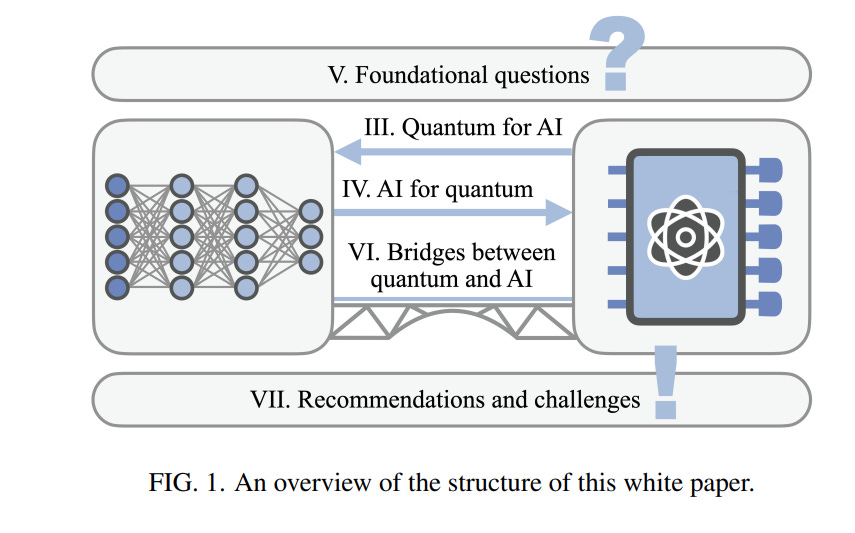
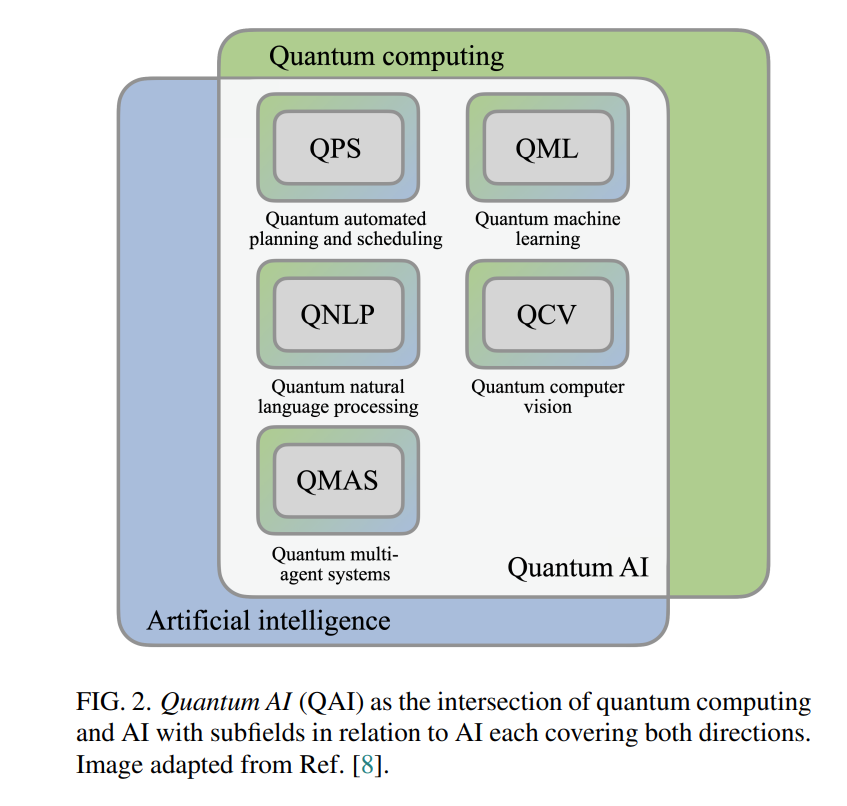
WHY it matters? QAI represents a pivotal convergence of two transformative technologies. This paper is significant as it offers a structured framework and a collective expert vision to navigate this intricate interdisciplinary field. By synthesizing current knowledge and outlining future trajectories (with its overall structure in Figure 1 and key subfields in Figure 2), it aims to guide researchers, industry stakeholders, and policymakers. The goal is to unlock QAI's potential to revolutionize science and technology, foster an innovation ecosystem, and address fundamental questions, making it an essential reference for understanding the opportunities and hurdles in this rapidly evolving domain.
Details
The convergence of artificial intelligence and quantum computing is rapidly solidifying its place as one of the most exhilarating and potentially transformative frontiers in modern science and technology. A recent, comprehensive white paper, "Quantum computing and artificial intelligence: status and perspectives", authored by a large consortium of leading experts, delves into this synergistic relationship. It provides a panoramic view of the current landscape and, crucially, offers a strategic vision for its future. This document isn't about a singular new algorithm; it's an invaluable roadmap for the burgeoning field of Quantum AI (QAI).
A Strategic Blueprint for Quantum AI
The primary contribution of this paper is its function as an early, consensus-driven proposal for a strategic research and industry roadmap in QAI. It meticulously explores the dual nature of this synergy: how quantum computing can augment classical AI capabilities, and how AI, in turn, can be a pivotal tool in advancing quantum technologies themselves.
Key novel aspects of this white paper include:
A holistic, multi-timescale research agenda outlining short-term (3-5 years), mid-term (5-10 years), and long-term (beyond 10 years) goals across various QAI domains.
A comprehensive survey of QAI subfields, including quantum machine learning (QML), quantum reasoning, quantum planning, quantum natural language processing, and quantum computer vision (visualized in Figure 2).
A deep dive into foundational questions about learning in a quantum world, pushing beyond purely applied perspectives to consider the fundamental nature of intelligence in quantum systems.
A critical emphasis on trustworthiness, robustness, and interpretability for AI applications within the quantum technology sphere.
Methodological Framework: A Two-Way Street
The paper’s approach to dissecting QAI is structured along two primary investigative pathways:
Quantum for AI: This explores how quantum computing can enhance classical AI. The dominant strategy here is the development of hybrid quantum-classical architectures. This is a pragmatic choice, given the current Noisy Intermediate-Scale Quantum (NISQ) hardware, which is characterized by significant noise, limited qubit numbers, and short coherence times. The idea is to leverage quantum processors for computationally intensive subroutines where they might offer an advantage—such as in optimization, sampling, or handling high-dimensional data—while classical systems manage the rest. This includes:
Quantum-assisted Machine Learning (QML): Applying quantum algorithms to potentially accelerate training, reduce data requirements, or improve accuracy in supervised learning (e.g., using quantum kernels, which map classical data into high-dimensional quantum Hilbert spaces where patterns might be more easily discernible, or parameterized quantum circuits as trainable models), reinforcement learning (e.g., quantum agents or critics in actor-critic models), and unsupervised learning (e.g., quantum algorithms for clustering).
Broader AI Subfields: Extending potential quantum enhancements to areas like automated planning, reasoning, natural language processing, and computer vision.
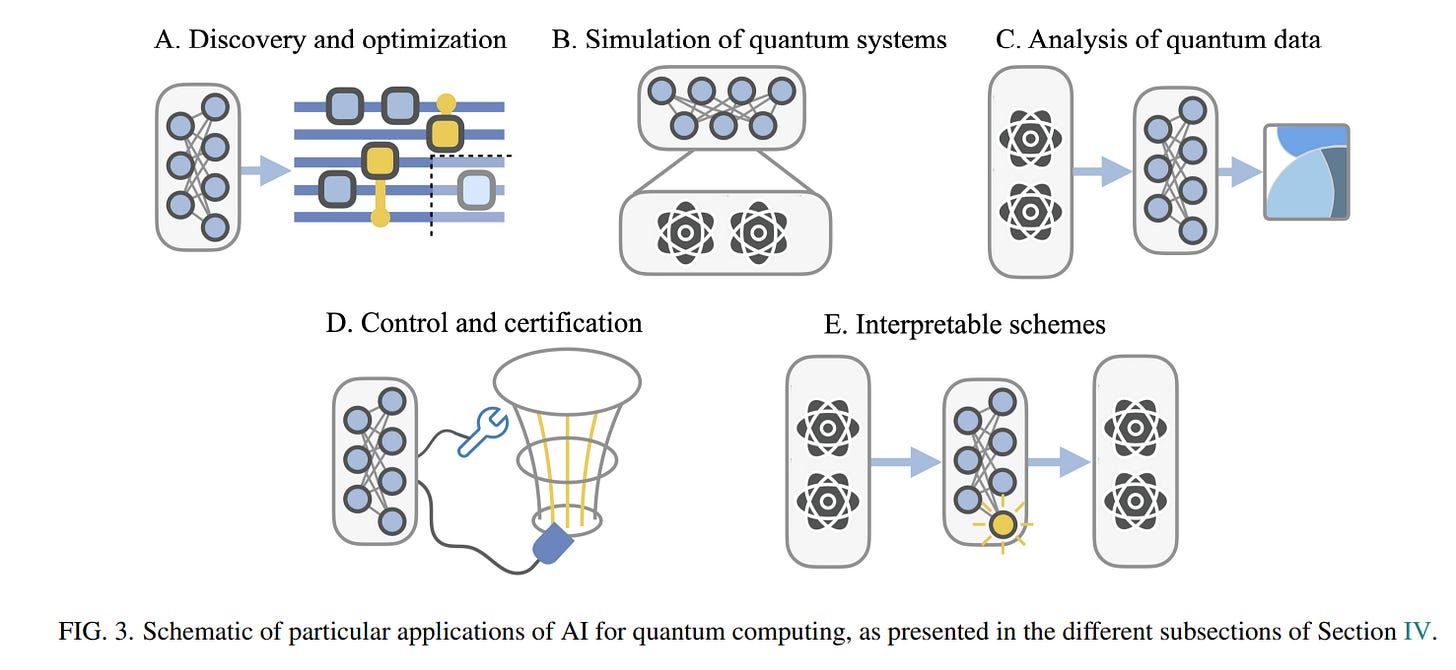
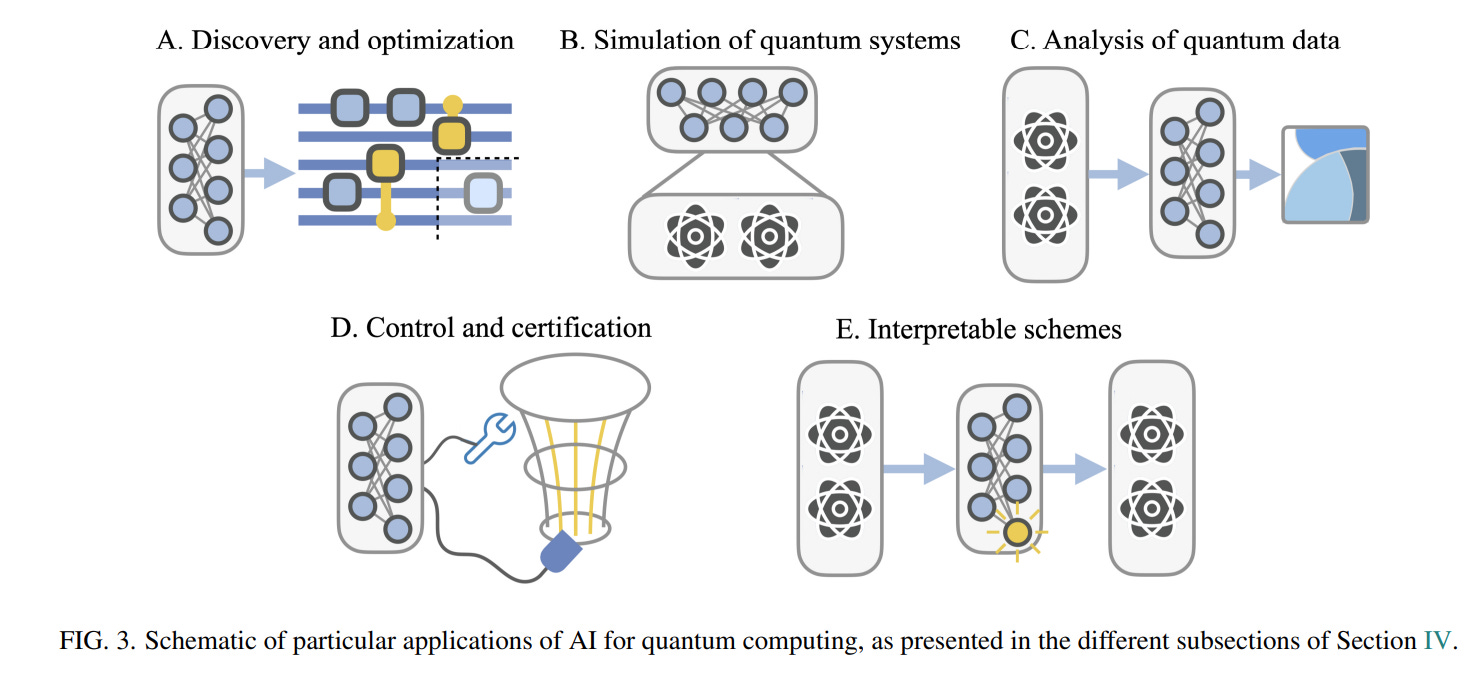
AI for Quantum: This pathway details how classical AI, particularly machine learning, can be instrumental in advancing quantum computing (illustrated in Figure 3).
The rationale here is that the sheer complexity of designing, controlling, and understanding quantum systems necessitates sophisticated automated tools. This encompasses:
Discovery and Design: Using AI for quantum architecture search, designing novel quantum algorithms, and optimizing quantum circuit compilation.
Simulation and Modeling: Employing AI to boost numerical simulations of complex quantum systems, for instance, through Neural Quantum States (NQS) or by creating AI-driven surrogate models and digital twins of quantum devices.
Data Analysis and Control: Leveraging AI for analyzing the complex and often noisy data from quantum experiments (e.g., for quantum state tomography) and for automated control, calibration, and error mitigation in quantum hardware.
Trustworthy AI: Developing interpretable and explainable AI methods tailored for quantum applications to ensure reliability and foster scientific discovery.
The overarching philosophy is to harness the unique properties of quantum mechanics (like superposition and entanglement) to tackle AI's challenging problems, while simultaneously using AI's prowess in pattern recognition and optimization to overcome the hurdles in building and operating robust quantum computers.
Key Claims and Reported Progress
As a survey, the paper synthesizes numerous claims and preliminary findings from the QAI research community:
Quantum computing offers theoretical speed-ups for certain AI tasks. For example, quantum algorithms for clustering like q-means theoretically promise exponential speed-ups for certain distance calculation subroutines, though they are reliant on the future development of large-scale, fault-tolerant quantum computers (FTQCs). Algorithms like HHL (https://arxiv.org/abs/0811.3171) offer potential acceleration in solving linear systems relevant to ML.
AI techniques are already enabling tangible progress in quantum computing. ML-based decoders for quantum error correction, for instance, have reportedly outperformed traditional decoders in accuracy for specific codes like the surface code.
Neural Quantum States (NQS) are presented as a versatile class of variational wave functions capable of representing complex quantum states, pushing the boundaries of numerical simulation.
AI is proving valuable for the automated control and calibration of quantum devices, leading to more efficient and higher-quality quantum operations.
The authors are, however, careful to note that many of these advantages, particularly significant speed-ups for broad AI tasks, are often contingent on FTQC development and face current challenges. These include efficient data loading into quantum states, and training issues like "barren plateaus" (where gradients vanish exponentially with the number of qubits, making the optimization of many quantum neural network architectures exceedingly difficult).
Impact, Future Horizons, and Unspoken Challenges
The paper paints a picture of QAI as a field with profound implications. For AI, it promises more efficient algorithms, the ability to tackle previously intractable problems, and new ways of understanding data. For quantum computing, AI offers the tools to accelerate development, improve control, and make quantum systems more robust and usable. This synergy is expected to drive breakthroughs in areas like drug discovery, materials science, financial modeling, and fundamental physics. It's also worth noting that the white paper frames many of its recommendations within the context of bolstering European research and industrial competitiveness in this strategic global field.
The authors lay out an extensive research agenda across various QAI domains. A particularly paradigm-shifting idea discussed is "learning as a physical process," where the natural dynamics of quantum systems might inherently perform learning tasks. This contrasts starkly with the traditional view of learning as an explicit algorithmic procedure executed on a distinct computational substrate, hinting at a more fundamental, emergent form of intelligence within physical systems themselves.
The paper also commendably calls for responsible innovation, referencing the EU's existing regulatory frameworks like GDPR and the AI Act, and emphasizes the importance of interdisciplinary collaboration, including with social sciences and humanities, to address the broader societal implications of QAI.
Beyond the explicitly stated limitations, the field faces deeper, sometimes unspoken, hurdles:
The assumption of widespread practical quantum advantage for general-purpose ML problems remains to be proven comprehensively beyond niche applications.
The fundamental redefinition of 'learning' in a quantum context, where principles like the no-cloning theorem (prohibiting perfect copying of unknown quantum states) and the inherently probabilistic and disturbing nature of quantum measurement necessitate entirely new theoretical frameworks for data handling, model training, and knowledge representation, is still in its infancy.
The extreme scalability demands on AI for controlling and verifying future fault-tolerant quantum computers (FTQCs) represent an unprecedented engineering challenge.
Practical overheads and latencies in hybrid quantum-classical systems could diminish or negate theoretical speedups in real-world scenarios.
Conclusion: A Landmark Contribution
"Quantum computing and artificial intelligence: status and perspectives" stands as a landmark contribution to the nascent field of QAI. It is not merely a literature review but a comprehensive strategic document that synthesizes current knowledge, articulates a compelling vision, and provides a structured roadmap for future exploration. Its breadth, depth, and the collective expertise of its numerous authors make it an invaluable resource for researchers, practitioners, and policymakers.
While the journey towards realizing the full potential of QAI is long and fraught with challenges, this white paper provides an essential guide for navigating its complex and exciting terrain. It successfully argues that the synergistic development of quantum computing and AI is not just a promising research avenue but a critical pathway toward future technological and scientific revolutions. This work will undoubtedly serve as a foundational reference and a catalyst for innovation in Quantum AI for years to come.