
Towards Execution-Grounded Automated AI Research
Authors: Chenglei Si, Zitong Yang, Yejin Choi, Emmanuel Candès, Diyi Yang, Tatsunori Hashimoto
Paper: https://arxiv.org/abs/2601.14525
Code: https://github.com/NoviScl/Automated-AI-Researcher
Affiliation: Stanford University
TL;DR
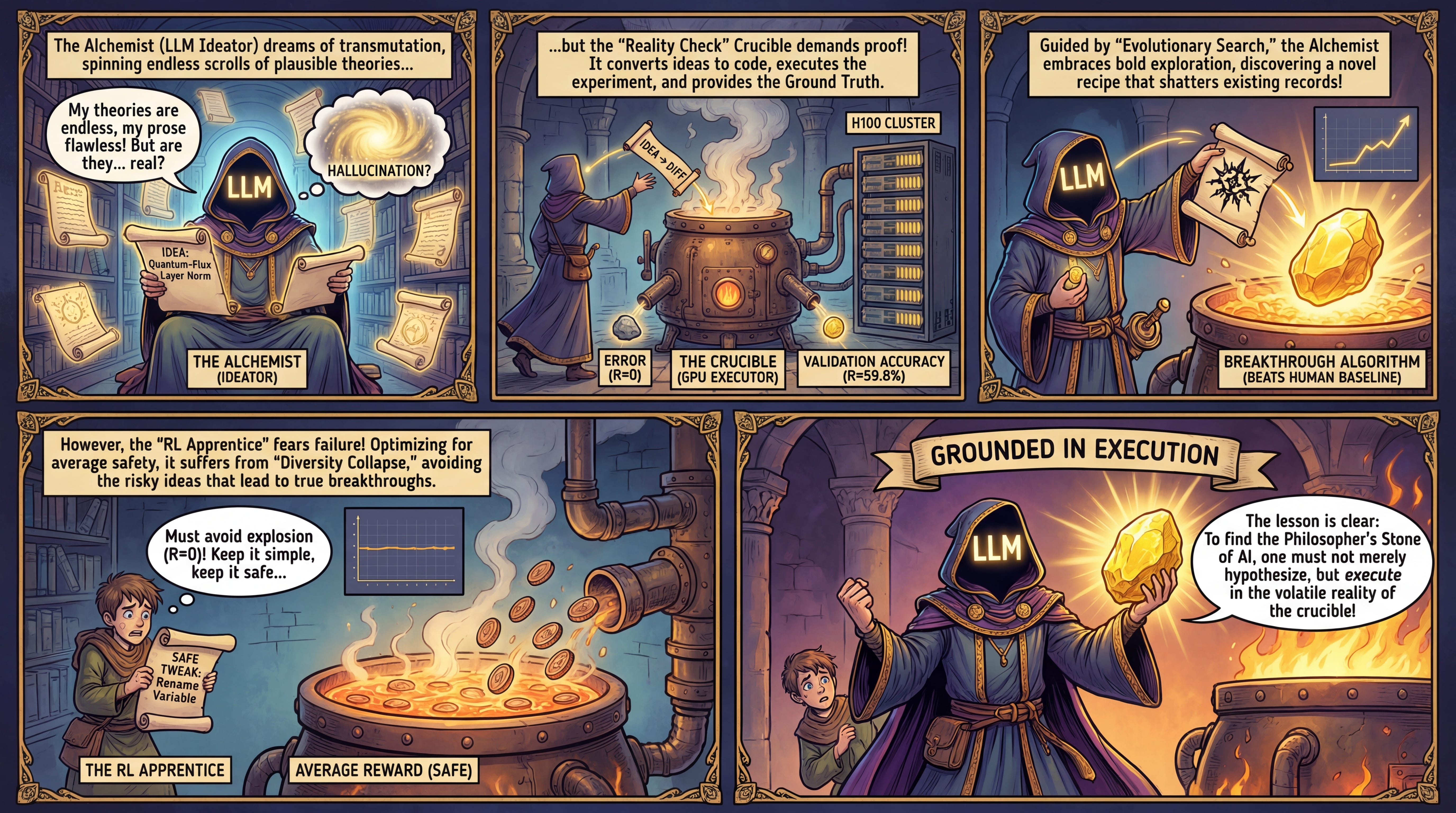
WHAT was done? The authors developed an end-to-end “Automated Idea Executor” that allows Large Language Models (LLMs) to not only propose research ideas but also implement them as code patches, execute them on GPUs, and receive ground-truth performance feedback. They utilized this execution feedback loop to improve the ideation capabilities of frontier models (like Claude 3.5 Sonnet and GPT-5) through two distinct methods: evolutionary search and Reinforcement Learning (RL).
WHY it matters? This work addresses the “hallucination bottleneck” in automated science, where agents generate plausible-sounding but functionally useless ideas. By closing the loop with actual execution, the authors demonstrate that LLMs can discover novel algorithms that outperform strong baselines (e.g., beating the best human performance on a specific GRPO task). Crucially, the paper reveals a counter-intuitive divergence in learning dynamics: while evolutionary search effectively discovers outliers, RL tends to suffer from mode collapse, optimizing for “safe,” simple code changes rather than scientific breakthroughs.
Details
The Validation Gap in Automated Science
The current landscape of “AI Scientist” agents is defined by a critical disconnect: models are proficient at reading literature and proposing hypotheses, but they often lack the agency to verify them iteratively to improve their own intuition. While frameworks like The AI Scientist perform execution to generate papers, they typically do not use that execution signal to train the ideator itself. This paper introduces the Automated Idea Executor, a system designed to bridge the gap between natural language ideation and empirical reality. By targeting two GPU-intensive research domains—LLM pre-training (improving nanoGPT efficiency) and post-training (improving GRPO on MATH)—the authors move beyond simple hyperparameter tuning into the realm of open-ended algorithmic discovery.
