
When Does Continual Learning Require Learning
Authors: Anne Harrington, Nayan Saxena, Michael Murphy, Anastasia Borovykh, Zeyu Yun, Sridhar Kamath, Ara Eindra Kyi, Trevor Darrell, Jitendra Malik, Yutong Bai
Paper: https://arxiv.org/abs/2607.07847
Code: https://github.com/anneharrington/studying-cl
Model: N/A
TL;DR
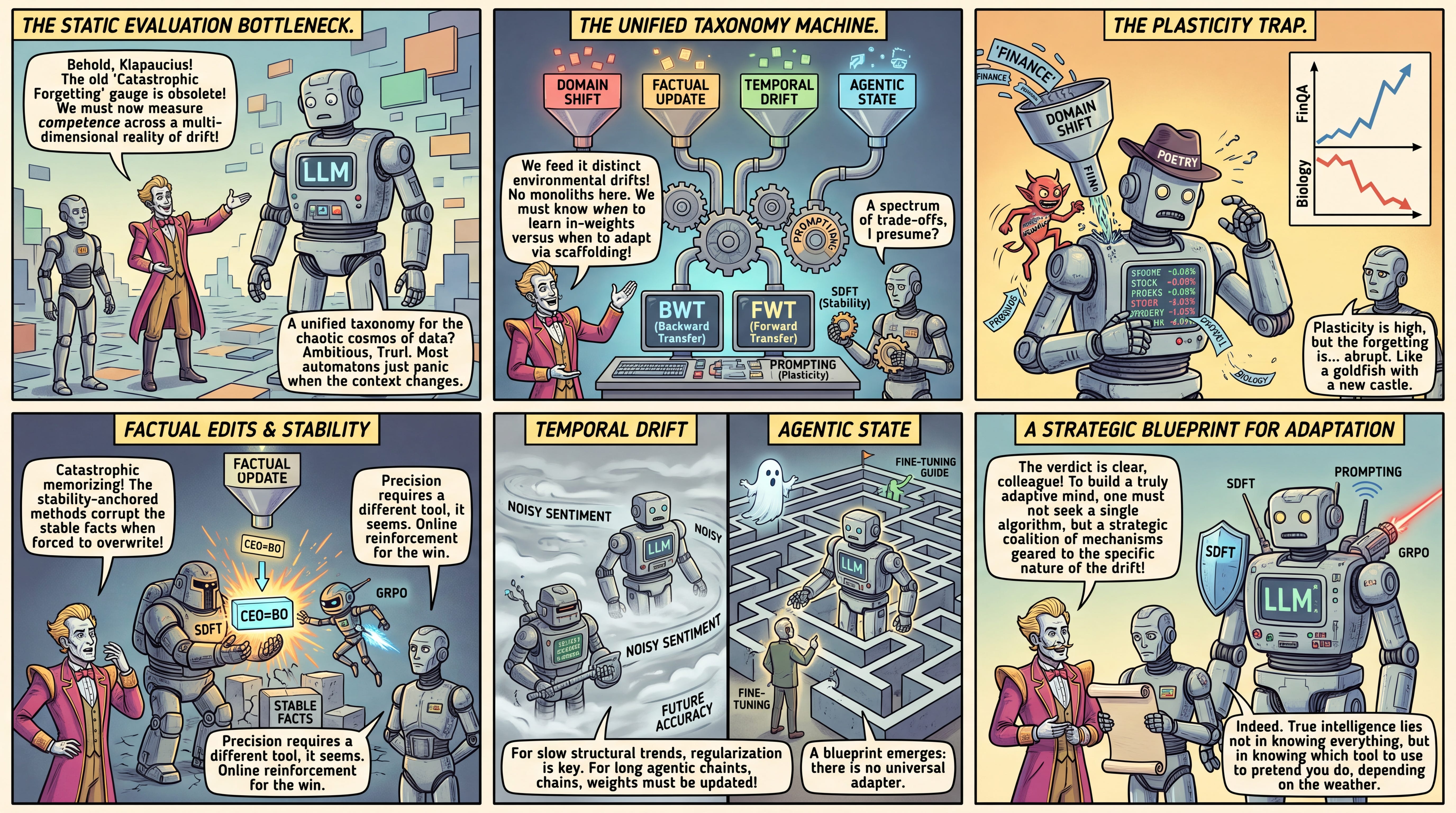
WHAT was done? The authors introduce a unified, mechanism-agnostic evaluation framework for continual learning in Large Language Models (LLMs). This framework evaluates and directly compares eight adaptation methods across prompting, supervised learning, reinforcement learning, and context compression over four realistic scenarios of environmental change: domain shifts, factual updates, temporal drift, and agentic state accumulation.
WHY it matters? It mathematically and empirically demonstrates that continual learning is not a monolithic capability but a series of distinct trade-offs dictated by the nature of environmental drift. No single adaptation method excels across all settings; slow temporal trends require stability-anchored distillation, discrete factual updates demand online reinforcement learning, and agentic environments require weight-based fine-tuning or specialized prompting, establishing a clear blueprint for when models must learn “in-weights” versus adapt through external scaffolding.
Details
The Static Evaluation Bottleneck and the Multi-Dimensional Reality of Drift
The rapid deployment of LLMs has exposed a massive gap between academic evaluation suites and production environments. Traditionally, the field of machine learning has framed continual learning narrowly around the concept of mitigating “catastrophic forgetting”—the problem of learning a new task without degrading performance on a previously learned task. This historical framing, designed for static datasets, fails to capture the multi-dimensional changes that deployed LLMs face. The authors of this work propose a critical delta from classical baselines by expanding the definition of continual learning to increasing model competence over time as the world changes. They categorize this evolution along two axes: space, which covers domain or task shifts, and time, which represents how underlying data drifts under a fixed task. By reframing standard static benchmarks into sequential streams, this paper exposes how current non-parametric scaffolding and parameter-updating methods fail to scale uniformly across these realistic scenarios.
The Mechanics of Drift: Spatial and Temporal First Principles
To establish a mathematically rigorous foundation, the state space of the model and the mathematical representation of environmental drift must be clearly defined. Let the base model be represented by the initial state θ0=θbase. The environment presents a sequence of stages T1,…,TK, where each stage Tk defines a training distribution Dktr and an associated evaluation set Dkeval. Between stages, the learner updates its state dynamically via an unrestricted update operator Uk, yielding:
In this formulation, the state θk is a generalized variable representing updated model parameters, mutated system prompts, or modified external memory configurations depending on the family of the adaptation method. The evaluation of this state trajectory is represented by the forgetting matrix:
This matrix tracks the accuracy of model state i on the evaluation set of stage j. The system’s performance is distilled into two core transfer quantities. Backward Transfer, defined as:
measures whether later updates degrade performance on prior tasks, where a negative value indicates catastrophic forgetting. Forward Transfer, defined as:
assesses how effectively prior stages prepare the model to adapt to future, unseen tasks, capturing the acquisition of transferable structural knowledge.
From Data Stream to System State: A Mechanism-Agnostic Walkthrough
To understand how these different families of adaptation compete on equal footing, let us walk through a single running example under this protocol, as represented conceptually in the unified framework of Figure 1.
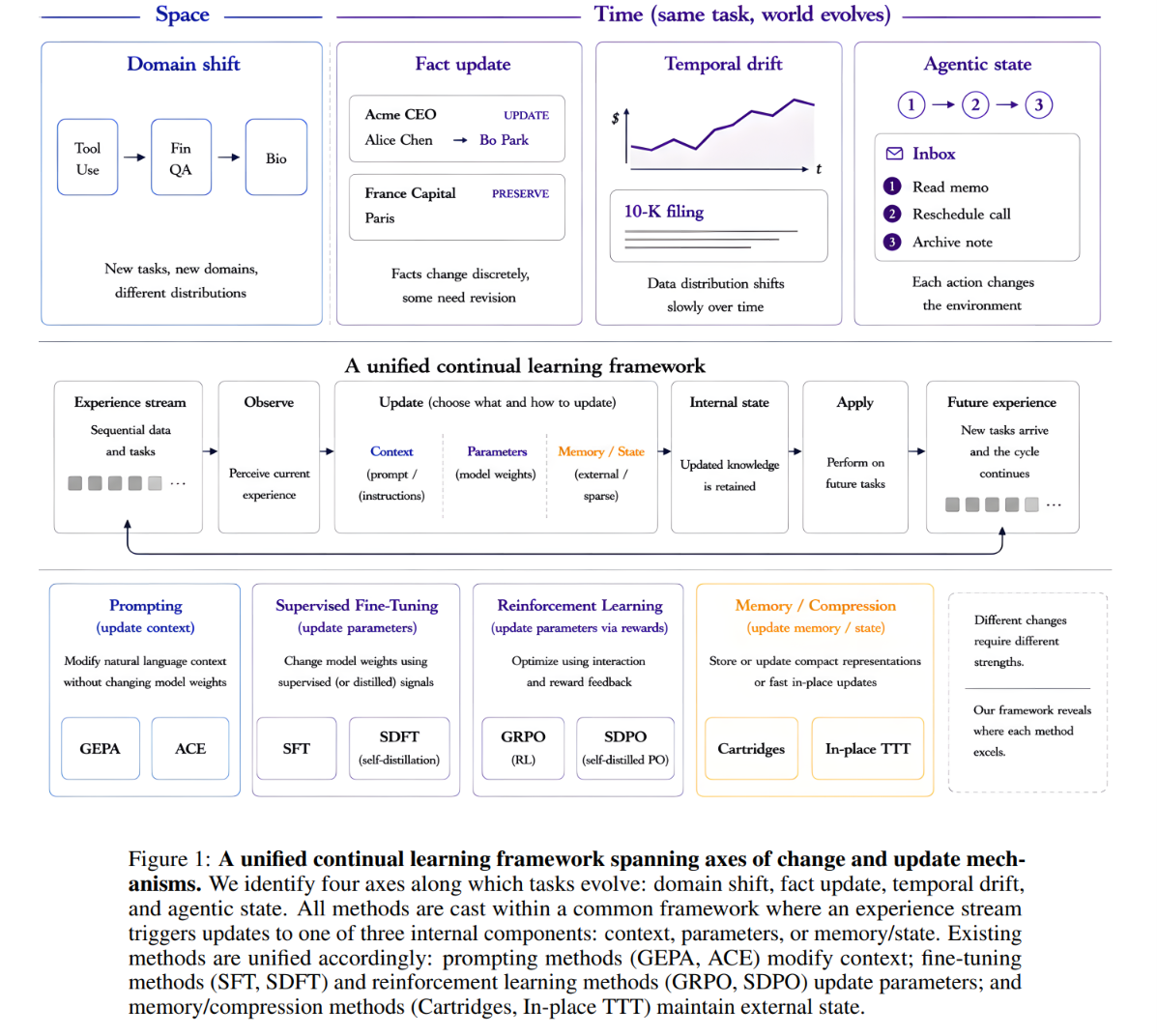
Suppose our model faces a temporal sequence of changes, beginning with domain shift (such as learning financial math after tool use) and transitioning to discrete factual updates (such as learning that the CEO of a company has changed from Alice to Bo). First, the input experience stream is observed by the learner. Depending on the method’s family, the update operator Uk triggers distinct internal updates. For a prompting method like Agentic Context Engineering (ACE) [review], the operator modifies the natural language context by prepending an incrementally updated markdown playbook to the prompt, keeping model weights frozen. For a supervised learning method like Self-Distillation Enables Continual Learning (SDFT) [review], the operator instead modifies the model parameter weights by fine-tuning on the new stage’s data while applying a forward-KL loss regularizer that pulls the student model towards the previous-stage teacher state θk−1. For a context-compression method like Cartridges, the base model is frozen, and the new data is compressed into a local, per-stage trainable KV cache which is loaded during evaluation. The output is then produced by executing the newly updated state θk on the task. This modular formulation ensures that all eight evaluated methods—ranging from prompt-based to fully parameter-updating architectures—compete under the exact same stage budget constraints and can be evaluated directly through the unified metrics of BWT and FWT.
Training Stability, Constraints, and Optimization Details
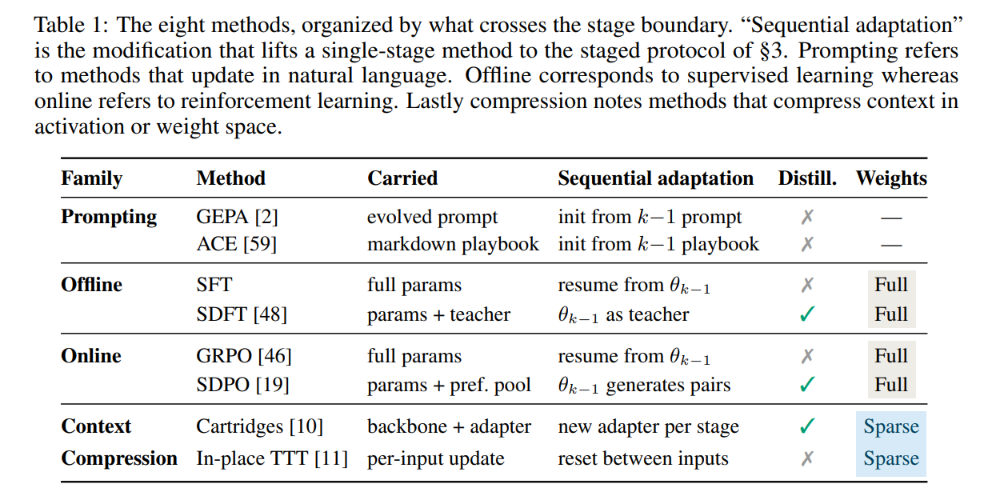
To ensure reproducibility and stable comparison, the authors run all evaluations on a common Qwen3-8B backbone. The weight-update methods (SFT, SDFT, SDPO, and GRPO) are optimized using a global batch size of 32, executing one epoch over 500 examples per phase, which equates to roughly 16 optimization steps. The outer learning rates are carefully tuned to prevent parameter collapse; for Self-Distillation Enables Continual Learning (SDFT) and Reinforcement Learning via Self-Distillation (SDPO) [review], the learning rate is set to 1×10⁻⁵ on the domain transfer task, whereas pure supervised fine-tuning (SFT) is constrained to a lower learning rate of 1×10⁻⁶ to prevent rapid gradient-driven collapse. For online reinforcement learning methods like DeepSeekMath (GRPO) and Reinforcement Learning via Self-Distillation (SDPO), the system utilizes 8 on-policy rollouts per prompt. SDPO optimizes a pairwise DPO loss over these rollouts while GRPO uses a PPO-style clipped objective with advantages z-scored across the rollout group. When implementing context compression, In-place Test-Time Training (In-place TTT) updates the fast weights of a sparse layer set index sequence given by [0,6,12,18,24,30,36] with an outer-loop learning rate of 5×10⁻⁶ and cosine decay. The hardware constraints were highly standardized, with each training phase completing in under one hour on a single node containing 8 NVIDIA H100 GPUs.
Empirical Dissection: The Diverging Paths of Plasticity and Stability
The experimental results reveal a striking trade-off across the four task regimes.
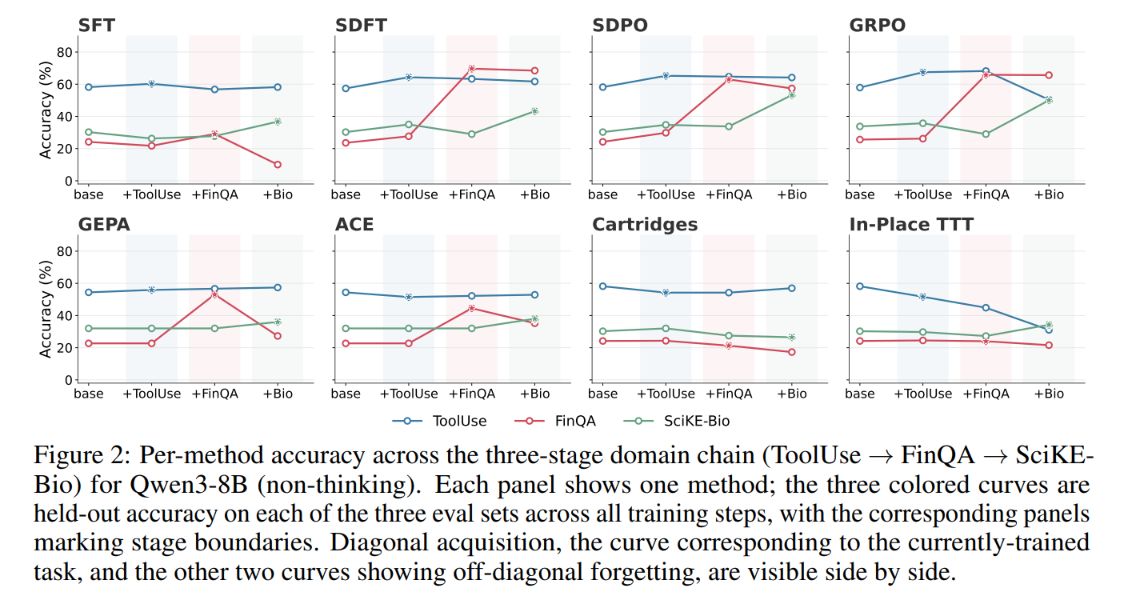
In the Domain Transfer setup shown in Figure 2, prompt-based methods like Reflective Prompt Evolution (GEPA) [review] show rapid adaptation to new domains but suffer from extreme catastrophic forgetting, as seen when FinQA performance drops by nearly 40% immediately upon transitioning to the biology task. Conversely, Self-Distillation Enables Continual Learning (SDFT) stably accumulates knowledge, finishing the chain with all tasks performing at or above zero-shot levels.
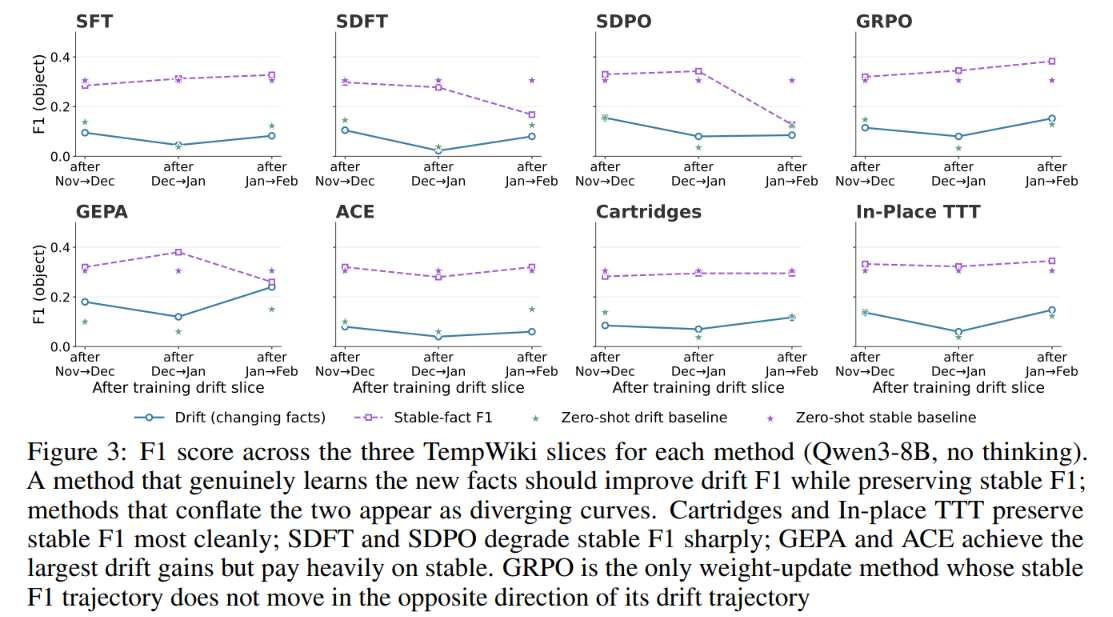
In the factual update (TempWiki) setting illustrated in Figure 3, a different trade-off emerges, which the authors term “catastrophic memorizing.” Here, the stability-anchored SDFT and SDPO struggle to overwrite old beliefs; by attempting to interpolate new facts against their existing distributions, they corrupt unrelated stable facts, causing stable-fact F1 scores to plummet from ≈0.30 to ≈0.15. Only GRPO manages to gain +6.2 points on drift facts at the second slice while keeping stable fact performance flat.
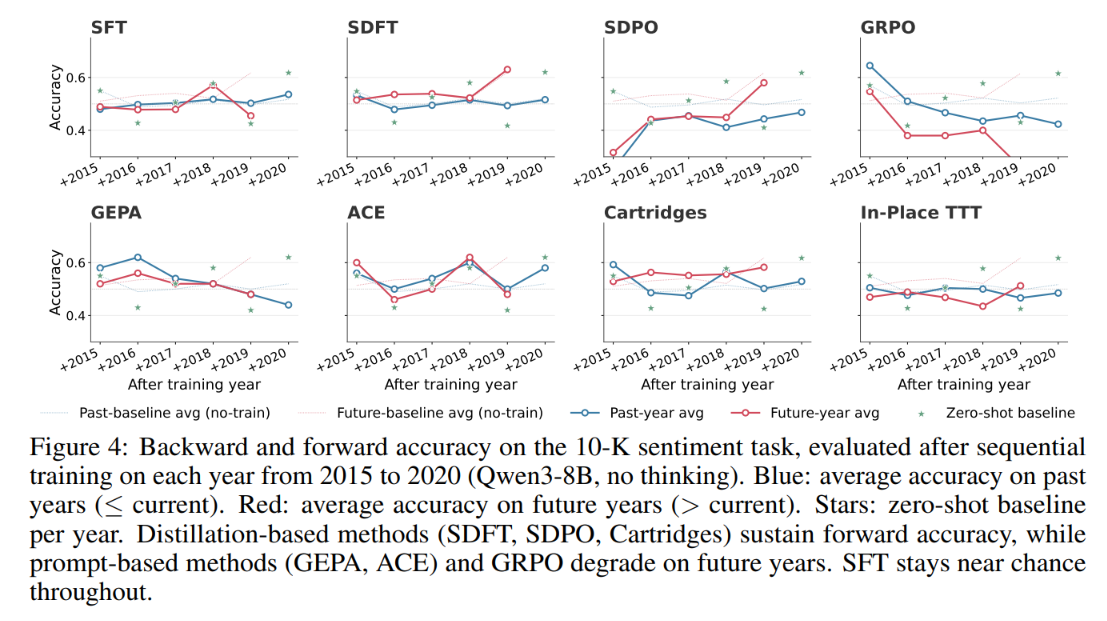
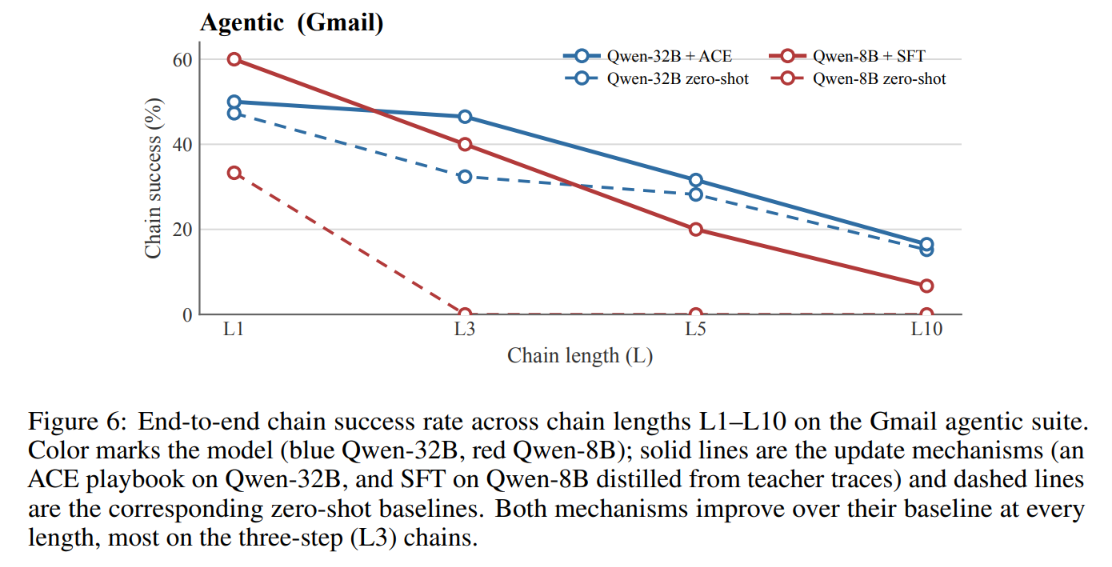
On the noisy 10-K sentiment drift task shown in Figure 4, GRPO collapses because the weak, noisy reward signals cause the algorithm to reinforce incorrect predictions, whereas SDFT’s regularization protects it, allowing future-year accuracy to climb to ≈0.62 by 2020. Finally, on the agentic suite in Figure 6, SFT on successful trajectories distilled from a larger teacher model recovers substantial performance across long chains, keeping the agent grounded where zero-shot baselines degrade completely.
Positioning the Framework within the Adaptation Landscape
This work synthesizes and directly compares several distinct threads of literature that have previously operated in silos. It builds on the classical formulation of transfer metrics pioneered by Gradient Episodic Memory (GEM) while adapting them to modern autoregressive architectures. It connects non-parametric inference-time scaling strategies, such as Retrieval-Augmented Generation (RAG) and Cartridges, directly against parametric gradient-based approaches. By doing so, it challenges the recent trend of treating continual learning purely as a prompt-engineering problem, exemplified by Agentic Context Engineering (ACE), or as a local test-time weight adjustment task, such as In-place Test-Time Training (In-place TTT). Instead, it positions these contemporary methods as points on a spectrum of state-updating mechanisms, demonstrating that their ultimate utility is highly dependent on the nature of the environmental drift they encounter.
Critical Weaknesses and the Scale-Proving Challenge
While the framework is robust, several key limitations must be noted. First, to maintain a controlled comparison, the authors run almost all evaluations on a single model size, Qwen3-8B. It remains an open question whether larger frontier models (such as 70B+ scale models) or models natively optimized for search-based reasoning would demonstrate different trade-offs, particularly regarding prompt optimization and context compression. Additionally, the benchmarks test environmental shifts in isolated, sequential blocks (e.g., pure domain shift, then pure fact updates). In actual production settings, these drifts occur simultaneously, unpredictably, and with varying degrees of severity, which may complicate the clean delineation of behaviors observed here.
Verdict: A Strategic Blueprint for Deployed LLM Architectures
This paper represents a crucial conceptual shift in how we think about continual learning. By moving past the narrow focus on catastrophic forgetting, it provides a comprehensive taxonomy of the trade-offs inherent to LLM adaptation. For AI system designers, the message is clear: do not expect a single update mechanism to handle every form of drift. Slow, structural trends require parameter-level regularization like Self-Distillation Enables Continual Learning (SDFT), while rapid factual edits require online reinforcement learning or direct prompting updates. This work is highly recommended reading for researchers working on agentic workflows and production LLM pipelines, serving as a foundational guide for building hybrid, multi-tiered adaptive AI systems.