
AlphaResearch: Accelerating New Algorithm Discovery with Language Models
Authors: Zhaojian Yu, Kaiyue Feng, Yilun Zhao, Shilin He, Xiao-Ping Zhang, Arman Cohan
Paper: https://arxiv.org/abs/2511.08522
Code: https://github.com/answers111/alpha-research
Model: https://huggingface.co/alpha-research/AlphaResearch-RM-Qwen-7B
TL;DR
WHAT was done? The paper introduces AlphaResearch, an autonomous agent that discovers new algorithms for open-ended problems. Its core innovation is a “dual research environment” that enhances the execution-based verification used in systems like AlphaEvolve. This environment adds a simulated peer-review mechanism, powered by a reward model (AlphaResearch-RM-7B) trained on over 24,000 ICLR peer-review records. This model evaluates the novelty and quality of a proposed idea before it is implemented, filtering out unpromising paths early. The authors also introduce AlphaResearchComp, a new open-source benchmark of 8 challenging algorithmic problems to ensure transparent and reproducible evaluation.
WHY it matters? This dual approach directly addresses the “ideation-execution gap,” a key challenge where AI-generated ideas are either innovative but infeasible, or feasible but scientifically uninteresting. By synergizing idea quality with execution performance, AlphaResearch accelerates meaningful discovery. This was validated when the agent discovered a new, best-of-known algorithm for the “Packing Circles” problem, surpassing solutions from both human experts and strong baselines like AlphaEvolve. The work represents a significant step forward, shifting the paradigm from just finding code that runs to discovering algorithms that are scientifically valuable.

Details
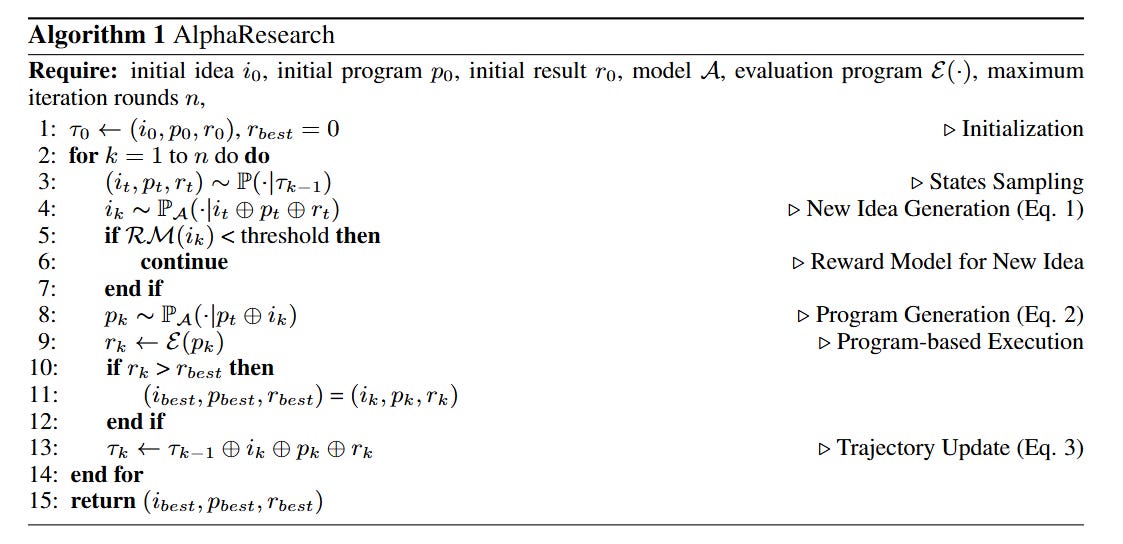
In the rapidly evolving field of AI-driven scientific discovery, systems like Google DeepMind’s AlphaEvolve (https://arxiv.org/abs/2506.13131, see also review and a deeper paper on AlphaEvolve results) have demonstrated that language models can autonomously discover advanced algorithms. These systems typically operate in an evolutionary loop, generating code variations and selecting for those that perform best according to execution-based metrics. A new paper introduces AlphaResearch, a system that builds upon this paradigm but argues that execution performance alone is not enough. It introduces a crucial second ingredient: a proxy for human scientific judgment.
There’s already a bunch of related papers beyond AlphaEvolve.
A somewhat related solution was also proposed in the DeepEvolve paper. There the authors proposed an automated debugging agent that resolves execution errors, dramatically improving the success rate of implementing complex ideas.
ShinkaEvolve paper introduced a smarter evolutionary loop comprising of sophisticated selection strategies, code novelty rejection-sampling mechanism, and powerful feedback loops by bandit-based LLM ensemble selection and meta-scratchpad.
Another paper used OpenEvolve, an open-source implementation of AlphaEvolve, and introduced a new research methodology called AI-Driven Research for Systems (ADRS). The methodology’s success hinged on a key insight: systems research is uniquely suited for AI automation because it naturally provides reliable, fast, and inexpensive “verifiers”.
AlphaResearch augments this mix by providing a unique reward model for evaluating research ideas.
The Core Innovation: A Dual Research Environment
The central contribution of AlphaResearch is a novel dual research environment designed to bridge the “ideation-execution gap.” This gap represents a fundamental tension: systems that prioritize novel ideas often produce concepts that are computationally infeasible, while systems focused purely on execution can converge on solutions that are technically correct but scientifically trivial.
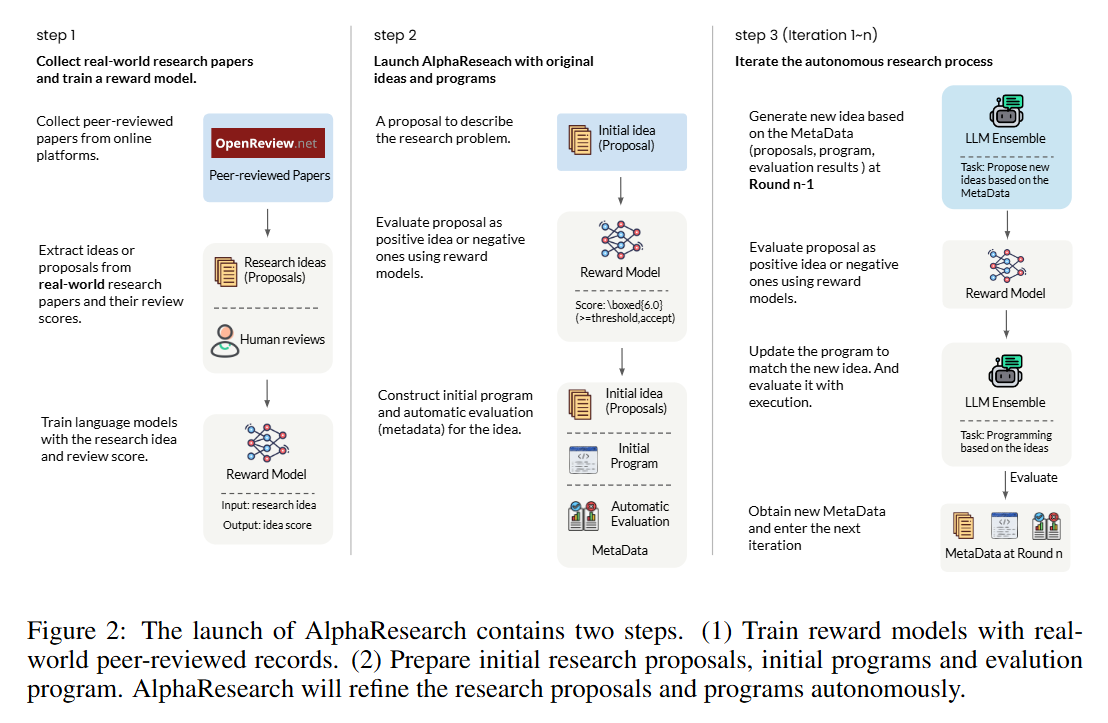
AlphaResearch tackles this by combining two feedback mechanisms (Figure 2):
Program-Based Verification: Like its predecessors, the agent generates code that is executed and evaluated against objective performance metrics. This ensures any proposed solution is feasible and correct.
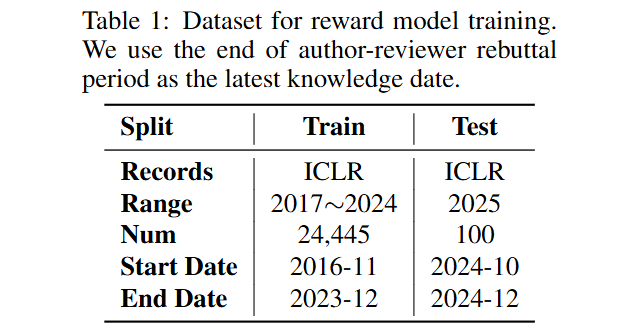
Simulated Peer Review: This is the key differentiator. Before committing to code generation and execution, a new research idea is first evaluated by a reward model named AlphaResearch-RM-7B. This model, a fine-tuned Qwen-2.5-7B-Instruct, was trained on 24,445 real-world peer-review records from the ICLR conference (2017-2024). It acts as a gatekeeper, assigning a score that reflects the idea’s novelty, rigor, and potential impact, effectively simulating the judgment of human reviewers. Ideas that fail to pass a quality threshold are discarded, saving significant computational resources.
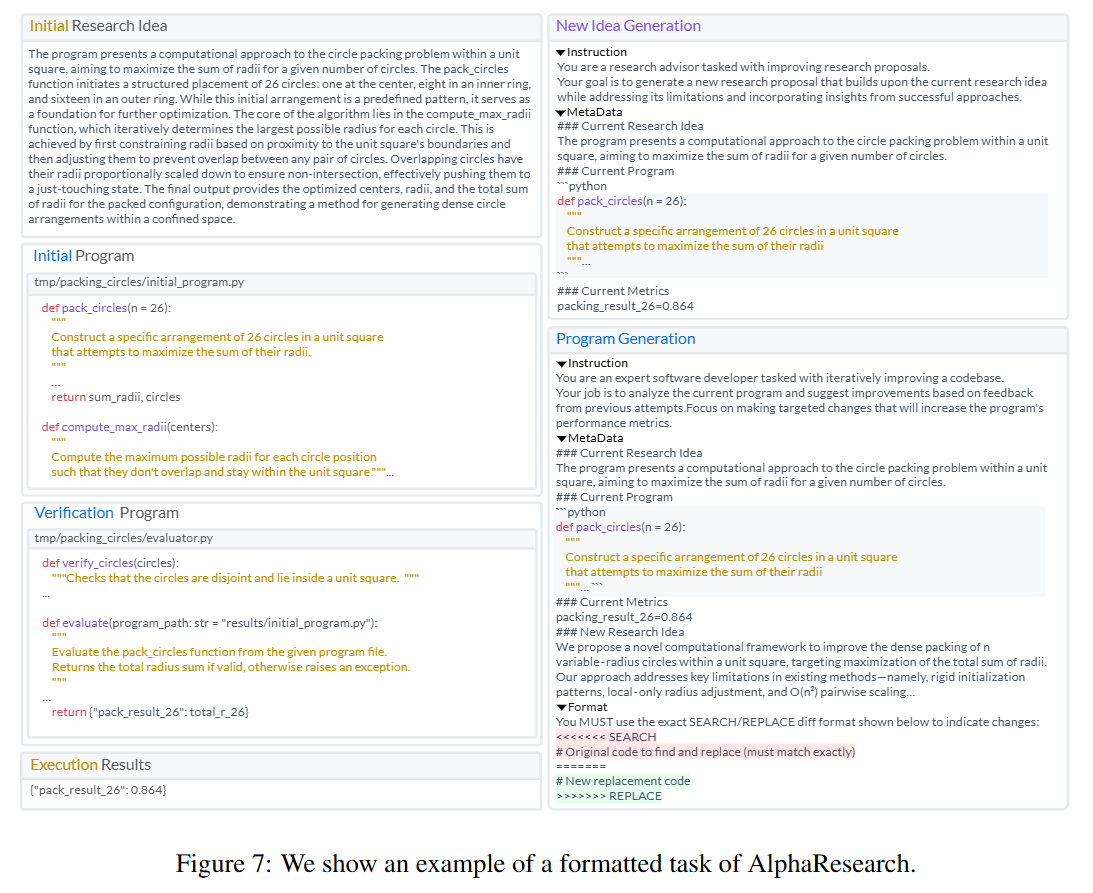
To make this process concrete, consider the “Packing Circles” problem (Figure 7). AlphaResearch might start with a simple program that places circles in a basic grid. After observing the result, it generates a new idea, such as: “We propose a novel computational framework... addressing key limitations in existing methods—namely, rigid initialization patterns and local-only radius adjustment.” If the reward model scores this idea highly, the agent then generates the specific code changes to implement this new, more sophisticated approach, and the cycle continues.
Experimental Results: A New Frontier in Circle Packing
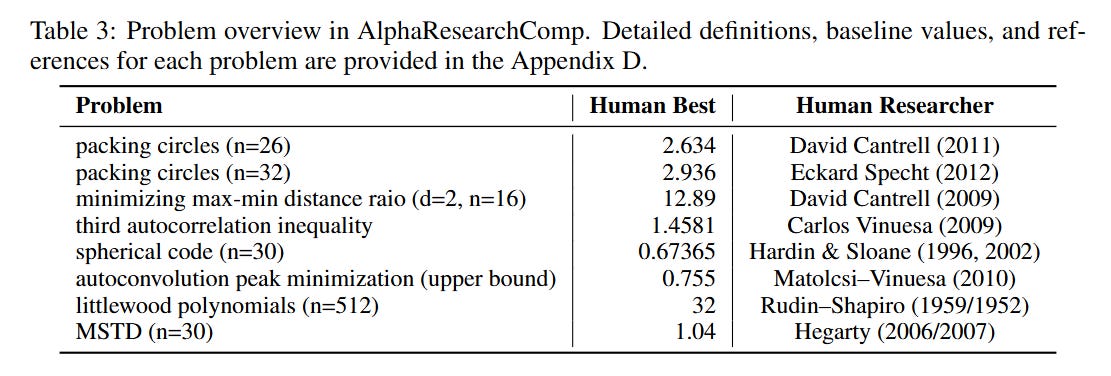
To test their system, the authors created AlphaResearchComp, a new, transparent benchmark of eight open-ended problems from geometry, number theory, and optimization. Performance was measured with excel@best, a metric proposed by the authors that quantifies the percentage improvement over the best-known human solution, cleverly accounting for whether a higher or lower score is desirable for a given problem.
The results are both impressive and humbling. AlphaResearch achieved a 2/8 “win rate” against human experts.
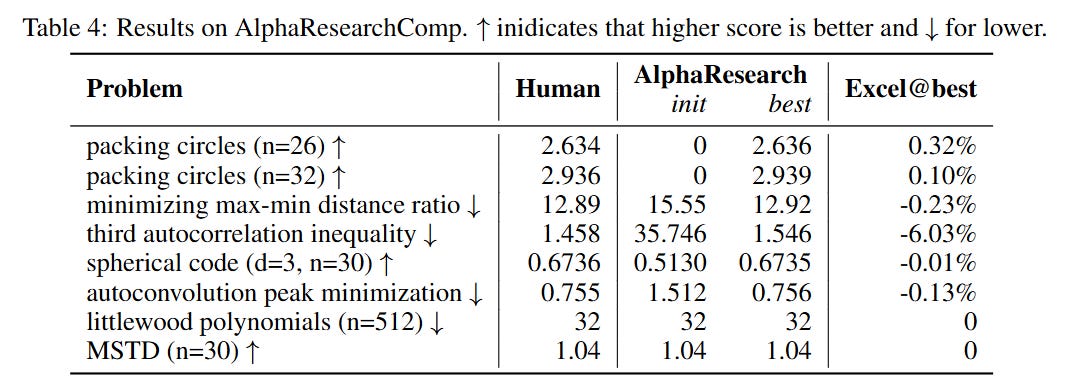
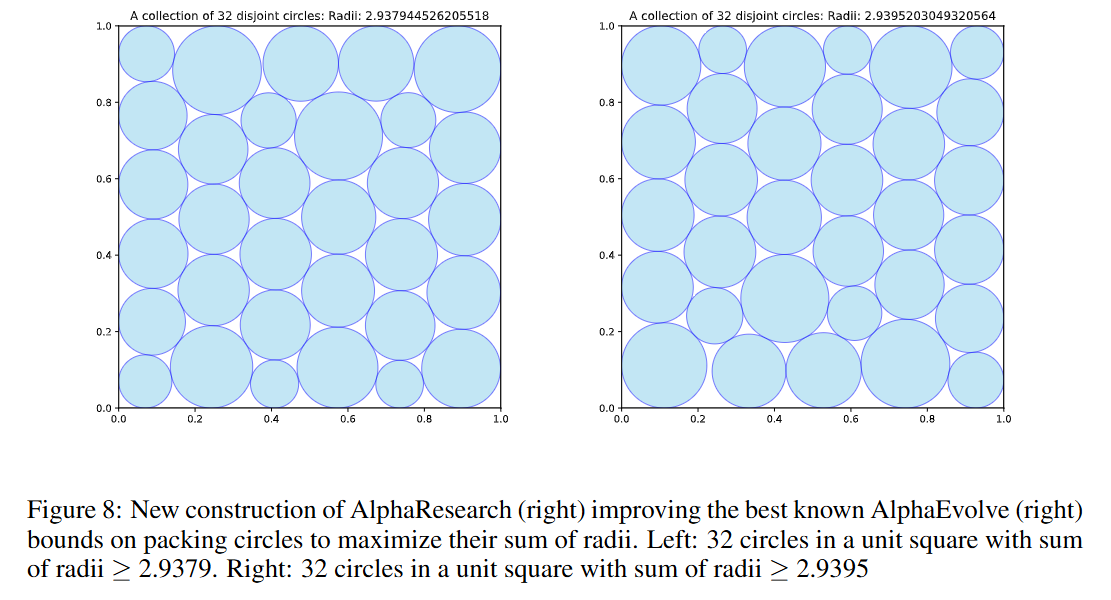
The most striking success came in the “Packing Circles” problem, which seeks to pack n disjoint circles into a unit square to maximize the sum of their radii. For n=32, AlphaResearch discovered an algorithm that achieved a score of 2.939, surpassing the best-known human result (2.936) and the prior state-of-the-art from AlphaEvolve (2.937) (Table 4, Figure 8).
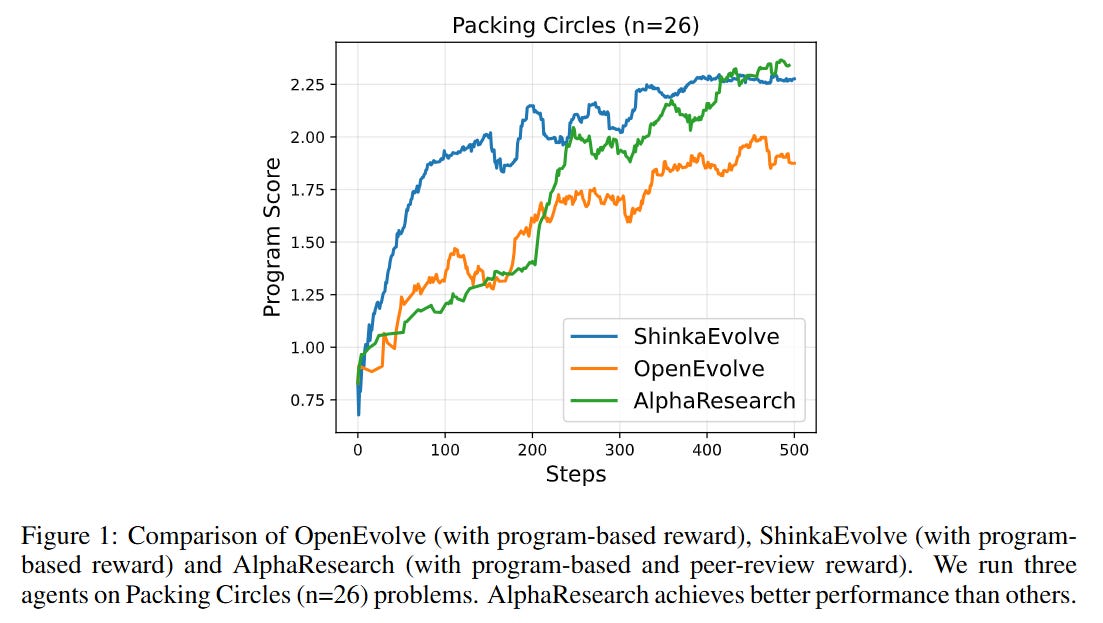
On this same problem, AlphaResearch also demonstrated superior performance against other recent evolutionary agents like OpenEvolve and ShinkaEvolve (Figure 1).
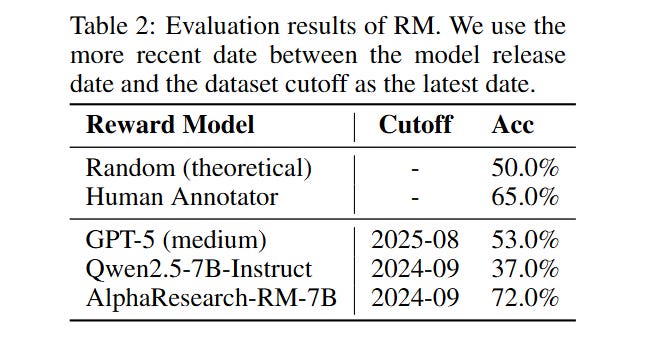
The effectiveness of the simulated peer-review mechanism was also validated. The AlphaResearch-RM-7B model achieved 72% accuracy in classifying the quality of unseen ICLR 2025 papers, significantly outperforming GPT-5 (medium) (53%) and human annotators (65%) (Table 2).
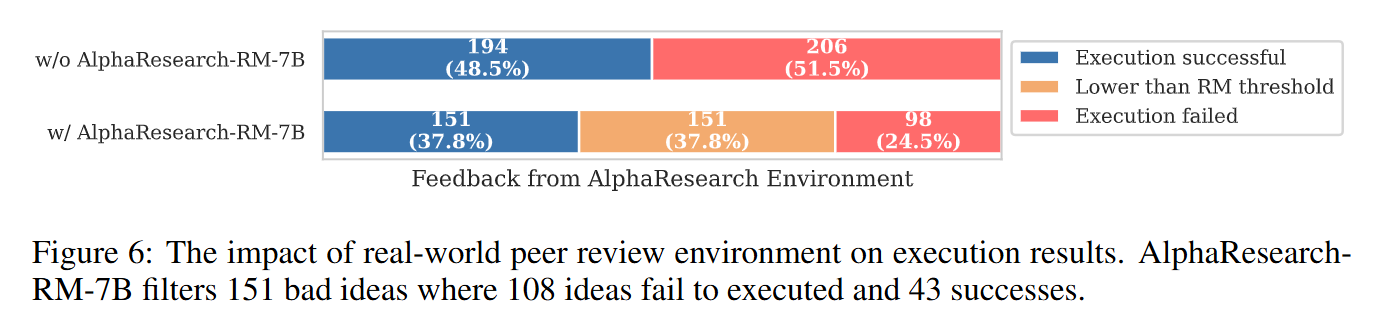
In practice, this filter proved highly effective, correctly rejecting 108 ideas on the Packing Circles problem that would have ultimately failed execution (Figure 6).
A Sobering Look at the Road Ahead
Despite this breakthrough, the results also highlight the immense difficulty of automated scientific discovery. The agent underperformed human experts on 6 of the 8 benchmark problems. Crucially, the authors tested their agent under different conditions: starting from scratch (as with ‘Packing Circles’), moderately initialized, or even starting with the best-known human solution. In the latter case, for problems like “Littlewood Polynomials,” the agent failed to find any improvement, highlighting the immense challenge of surpassing optimized human ingenuity.
Conclusion and Impact
AlphaResearch presents a compelling evolution of autonomous discovery agents. By integrating a simulated peer-review process, it refines the search for new algorithms to favor not just what works, but what matters scientifically. The discovery of a new best-of-known solution for a classic mathematical problem is a powerful proof-of-concept.
This work, along with its open-source benchmark and code, provides a valuable contribution to the field. It suggests that the future of AI scientists lies in hybrid systems that combine the raw power of execution-based optimization with a nuanced, data-driven understanding of what constitutes a good idea. While the path to fully autonomous AI researchers is long, AlphaResearch has charted a promising new direction.