
Autodata: An agentic data scientist to create high quality synthetic data
Authors: Ilia Kulikov, Chenxi Whitehouse, Tianhao Wu, Yixin Nie, Swarnadeep Saha, Eryk Helenowski, Weizhe Yuan, Olga Golovneva, Jack Lanchantin, Yoram Bachrach, Jakob Foerster, Xian Li, Han Fang, Sainbayar Sukhbaatar, Jason Weston
Paper: https://arxiv.org/abs/2606.25996
Code: N/A
Model: N/A
TL;DR
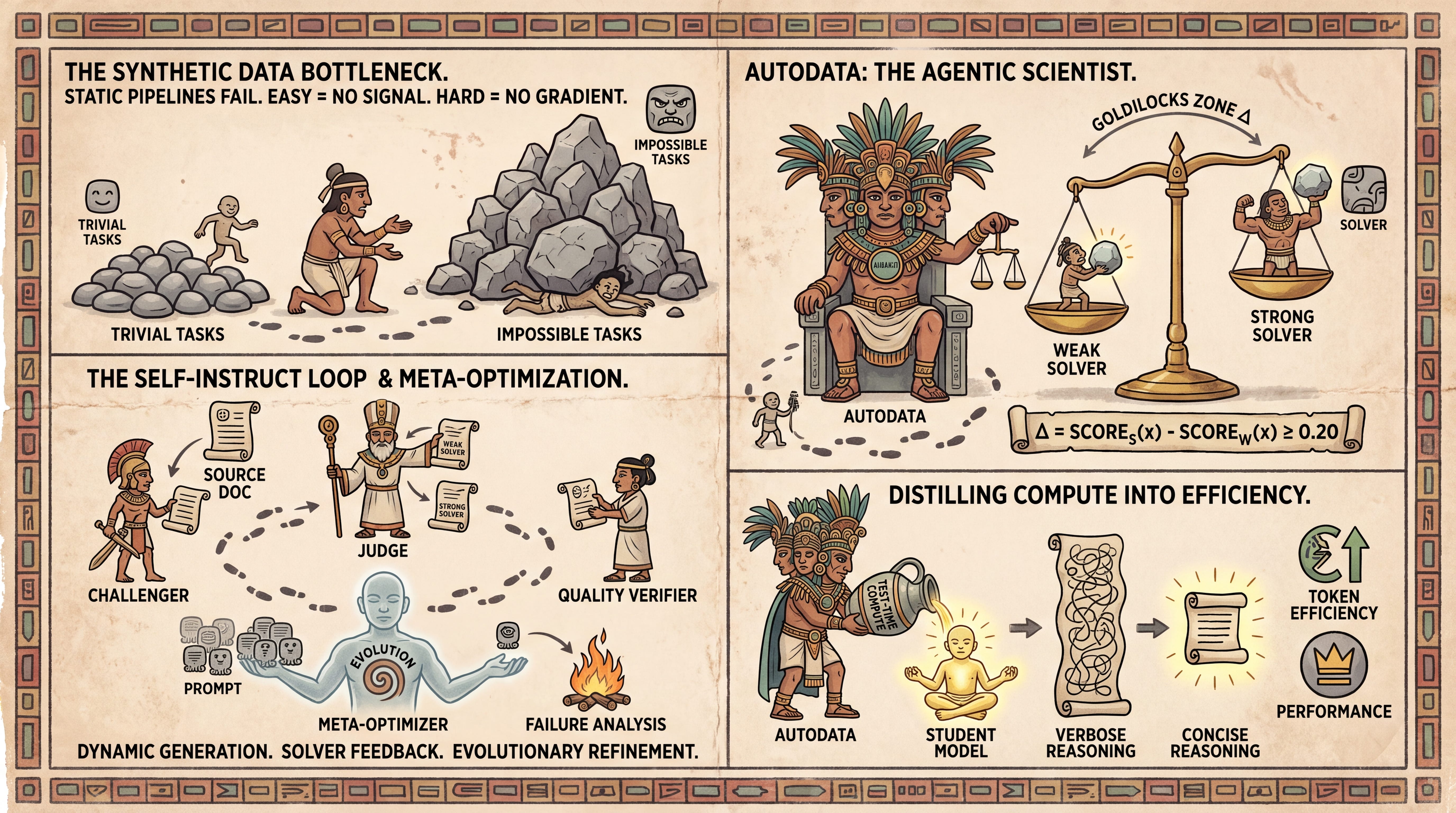
WHAT was done? The authors introduce Autodata, a framework that empowers large language model agents to act as autonomous data scientists. Rather than using static prompt templates or basic filtering pipelines, Autodata employs a closed-loop system of generation, solver-based evaluation, failure analysis, and recipe refinement, alongside an evolutionary outer loop that automatically meta-optimizes the system’s own prompts.
WHY it matters? As proprietary frontier models approach human performance on standard benchmarks, the supply of high-quality human data is bottlenecked, and standard synthetic data generation often yields tasks that are either too trivial or impossibly difficult. Autodata provides a systematic approach to convert massive inference-time search compute into structured, “just right” training curricula, improving downstream model alignment and significantly increasing token-level reasoning efficiency.
Details
The High-Performance Synthetic Data Bottleneck
State-of-the-art model training increasingly relies on synthetic data generation, but classical techniques like Self-Instruct or CoT Self-Instruct [review] suffer from a fundamental mismatch. They treat dataset creation as a feed-forward prompting pipeline with simple post-generation filtering. This static approach cannot adapt to the specific learning frontier of a target model. When applied to complex reasoning domains, standard synthetic data generation either creates questions that are too easy, yielding zero training signal, or generates problems so difficult that reinforcement learning algorithms cannot find a path to a correct solution. This binary failure mode represents a major barrier to efficient post-training, motivating a shift toward dynamic, model-in-the-loop curation frameworks that can intelligently adjust difficulty based on real-time solver feedback.
First Principles of Solver-Based Difficulty Calibration
The core theoretical assumption underlying Autodata is that high-quality training data must lie within a “Goldilocks Zone” relative to the target model. If we define W as a “weak solver” (the model we intend to train) and S as a “strong solver” (a larger, more capable model or a version of W utilizing increased inference compute), the utility of a synthetic task x is determined by the performance gap of these solvers. Let the score of a solver on a task be defined as a metric bounded between zero and one. The target objective is to generate tasks where the strong solver succeeds while the weak solver fails, maximizing the capability gap:
For open-ended tasks like computer science research questions, this objective translates into a hard threshold requiring ScoreS(x)≥0.65 and ScoreW(x)<0.50 with a net gap Δ≥0.20. Conversely, in highly complex legal reasoning tasks, standard generation produces questions that are far too difficult for the weak solver, resulting in all-zero reward rollouts that completely starve the reinforcement learning gradient. In this scenario, the agentic loop acts as a stabilizer, actively reducing complexity to find the exact threshold where the weak solver can begin to register a learning signal, effectively reshaping the rollout distribution to establish a viable gradient path.
The Agentic Self-Instruct Loop in Action
The framework utilizes a multi-agent system to drive this loop, orchestrating a flow from raw source material to a finalized, verified training sample as illustrated in Figure 1 and Figure 2.
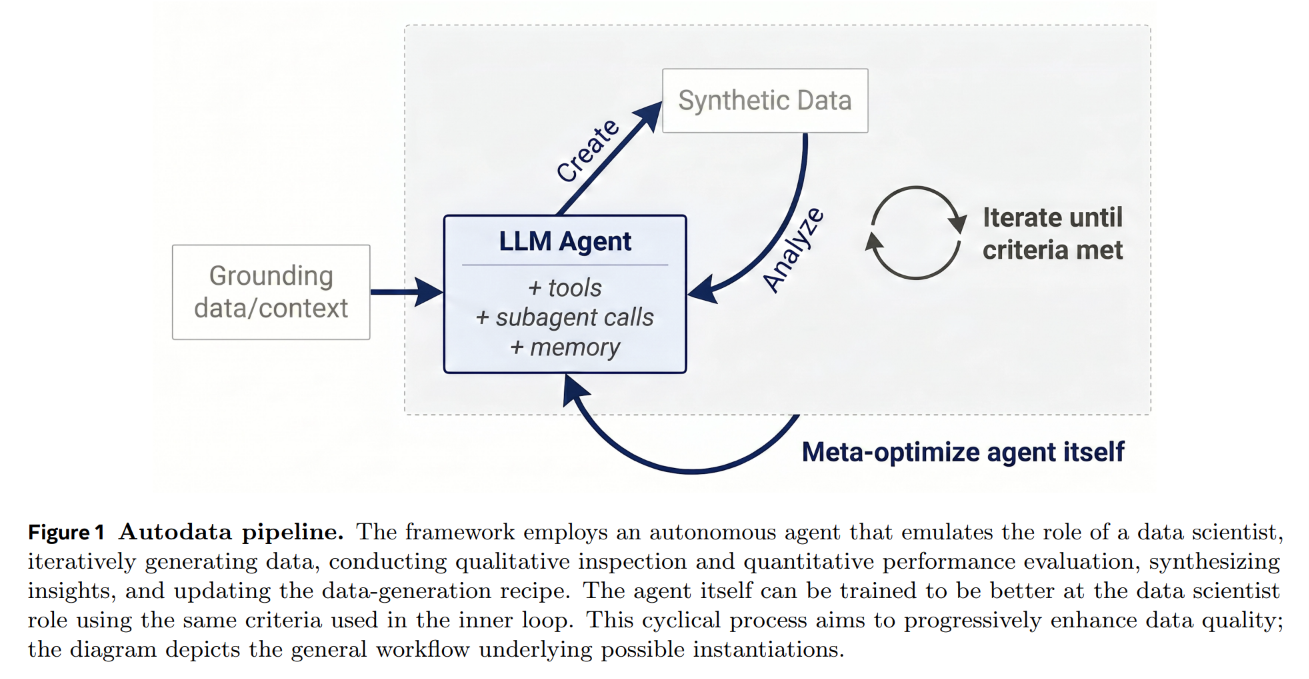
For a running example, consider an academic paper on Large Language Models from the S2ORC corpus used as the grounding context. The orchestrator agent initiates the process by passing the document to the Challenger subagent, which generates a candidate question, a reference answer, and a multi-criterion evaluation rubric. This generated package is evaluated by a Quality Verifier to check for context leakage or malformed rubrics. If verified, the question and context are dispatched to the Weak Solver (Qwen3.5-4B) and the Strong Solver (Qwen3.5-397B), each invoked multiple times to mitigate rollout variance.
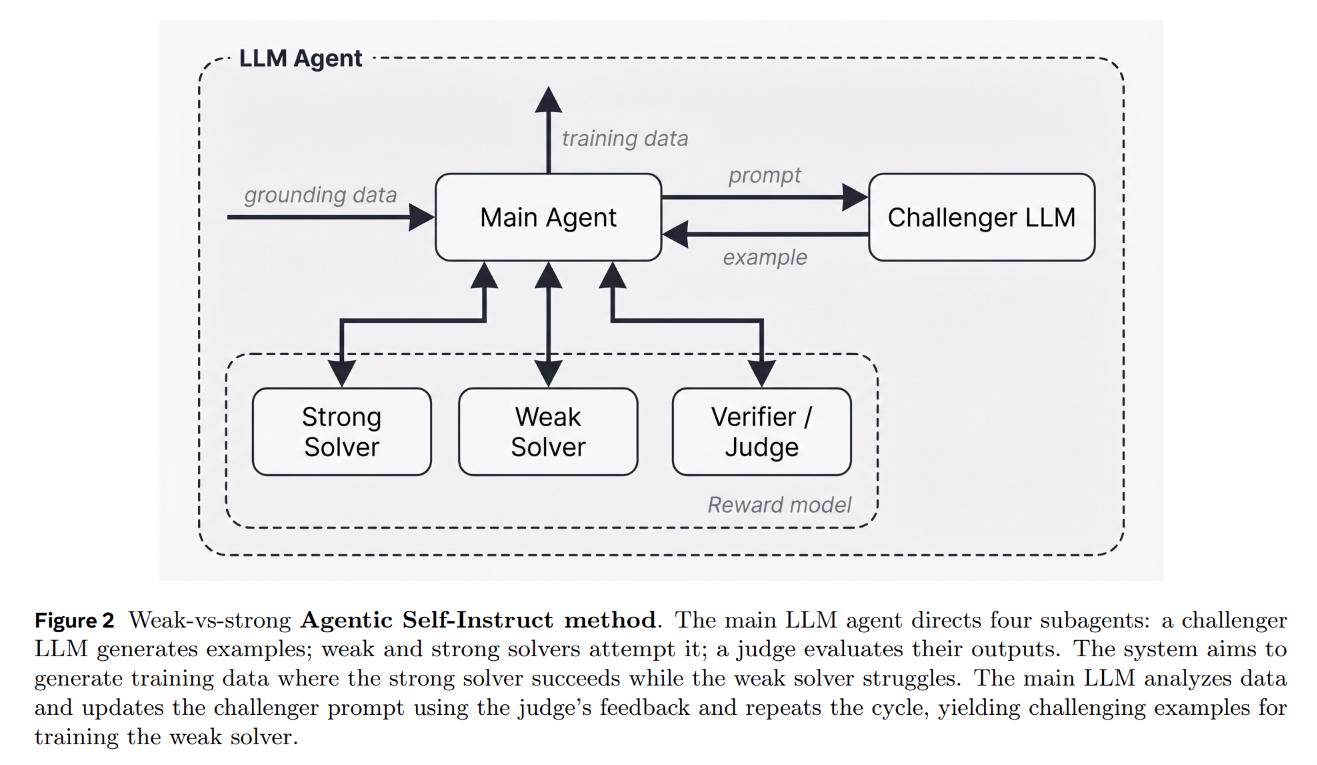
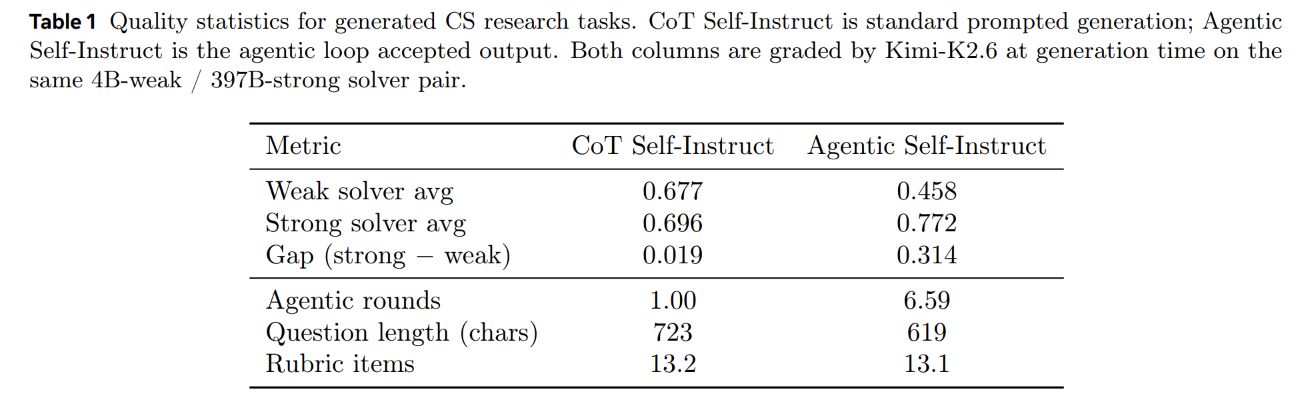
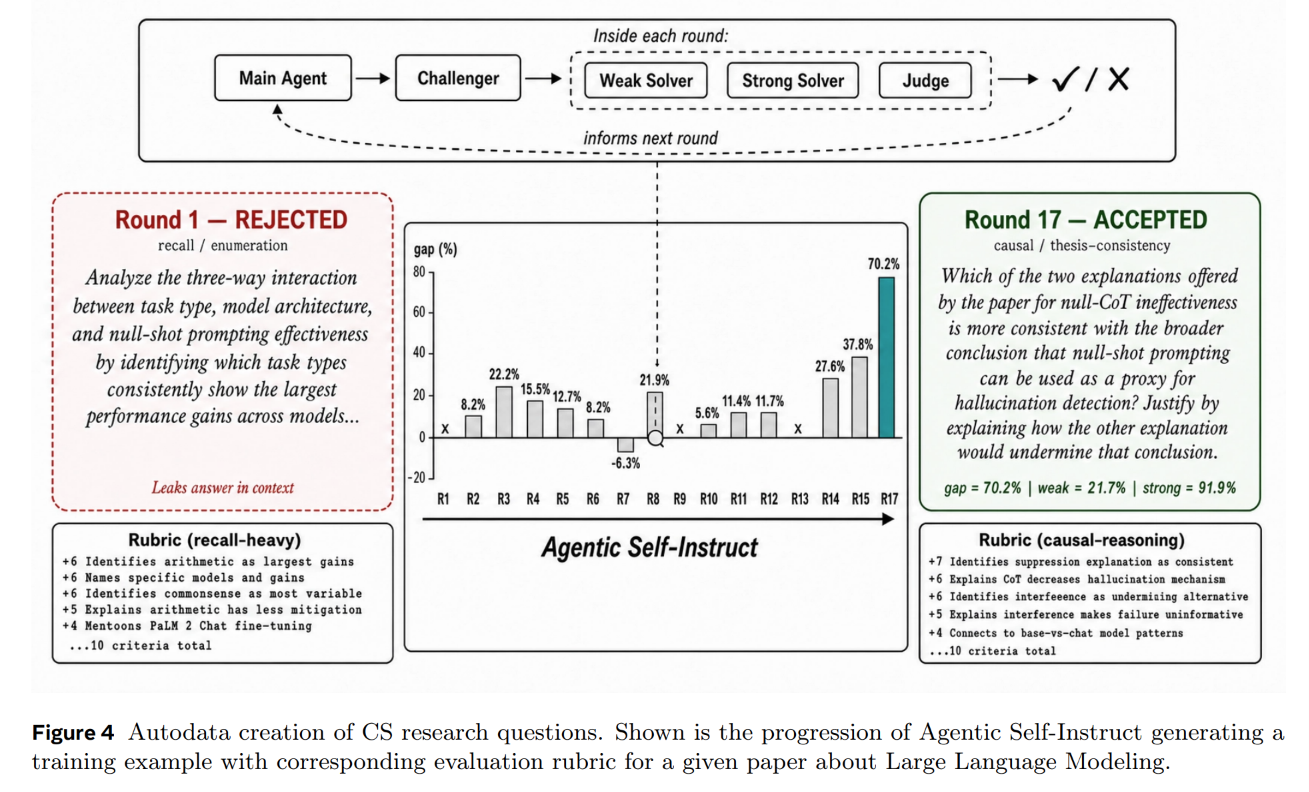
A Judge subagent (Kimi-K2.6) evaluates the generated solutions against the rubric on a per-criterion basis. If the solvers’ performance gap does not satisfy the target threshold (for example, if the question is too superficial and the Weak Solver scores a high average of 0.68), the main orchestrator agent halts acceptance. Instead of discarding the work, the orchestrator compiles a diagnostic report summarizing why the task failed to discriminate. It instructs the Challenger to modify its generation strategy, pushing it to pivot toward specific algorithmic steps or detailed ablation claims from the source paper. The Challenger then attempts a new generation angle. This iterative cycle repeats across multiple rounds—averaging 6.59 rounds in computer science tasks, as visualized in the step-by-step progression of Figure 4—until a discriminating, high-quality question is accepted or the step budget is exhausted.
Stabilization, Optimization, and Evolutionary Meta-Learning
Beyond running a fixed agentic loop, the Autodata system introduces an outer loop to automatically meta-optimize the system prompts of the data scientist agents. This outer loop, diagrammed in Figure 6, treats the agent harness and its instructions as code to be iteratively improved using an evolutionary framework.
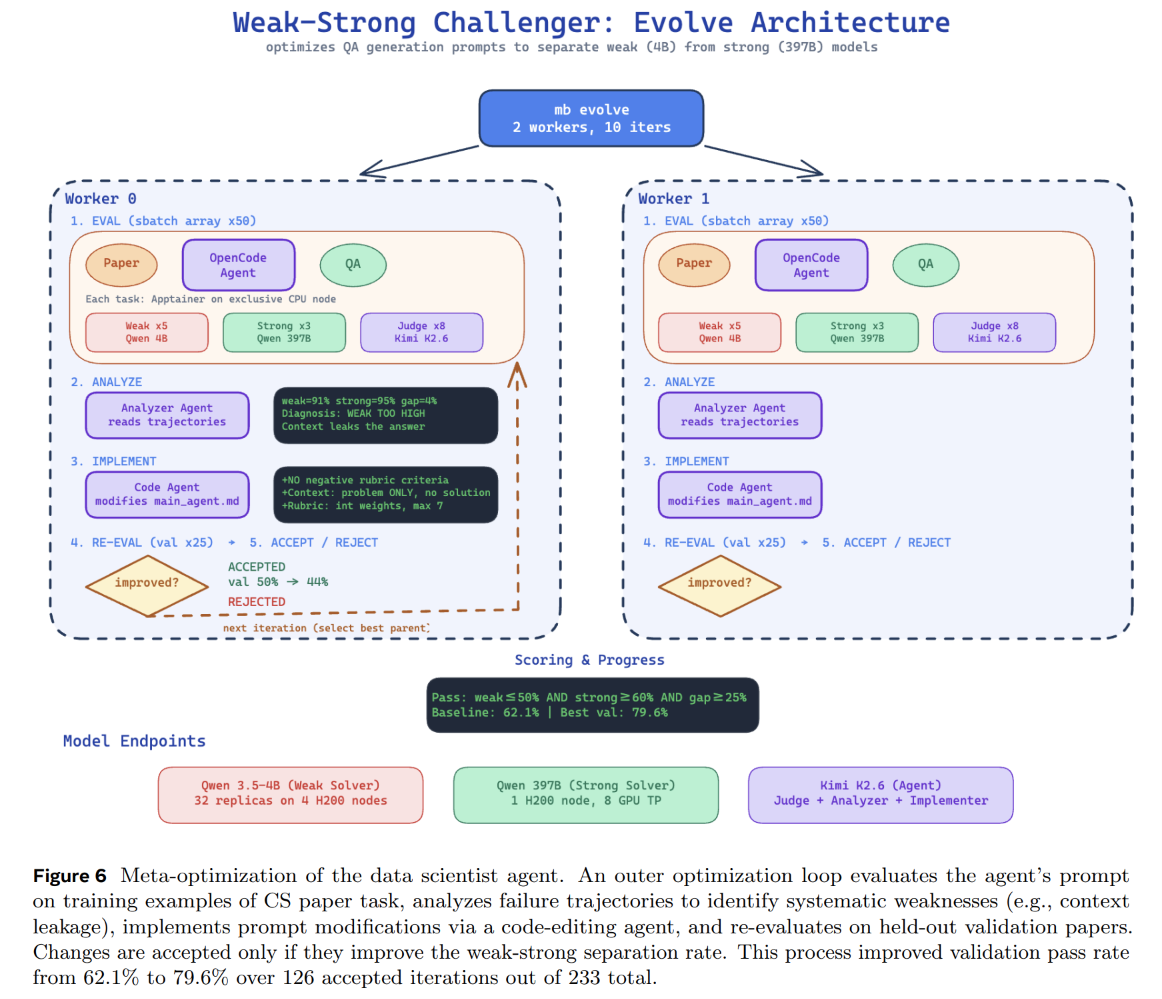
The meta-optimizer maintains a population of candidate prompts, selecting a parent prompt at each iteration using Boltzmann sampling:
where c is a candidate prompt, scorec represents its validation pass rate (the fraction of generated tasks that successfully separate the weak and strong solvers), and T is a temperature parameter set to 0.1 to balance exploration and exploitation. An LLM analyzer reads the failure trajectories of the parent, writes a root-cause analysis of systematic failure patterns, and directs a code-editing agent to implement prompt modifications.
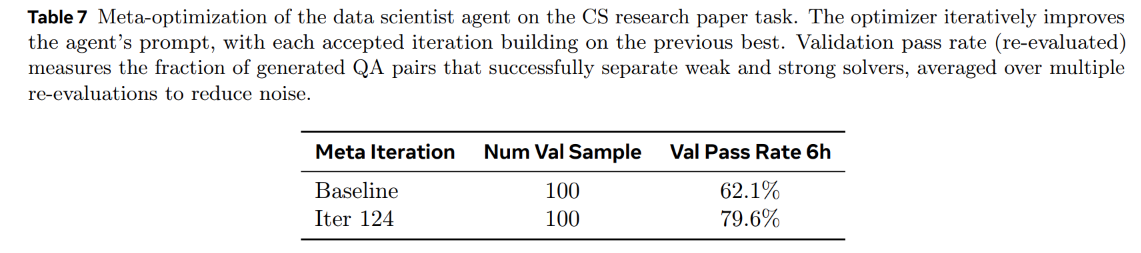
These modifications are evaluated on a minibatch of training and validation papers, and the mutant is accepted into the population only if its validation score strictly exceeds that of its parent. To handle this intensive parallel workload, the model endpoints are highly scaled: the Qwen3.5-4B Weak Solver runs 32 replicas across 4 H200 nodes, while the Qwen3.5-397B Strong Solver is deployed with 8-way Tensor Parallelism on a single H200 node. This meta-optimization loop successfully discovered counter-intuitive prompt designs—such as completely eliminating negative-weight rubric criteria in favor of capped positive integer weights—boosting the validation pass rate from 62.1% to 79.6% over 124 iterations, as documented in Table 7.
Empirical Evidence: Distilling Complexity and Token Efficiency
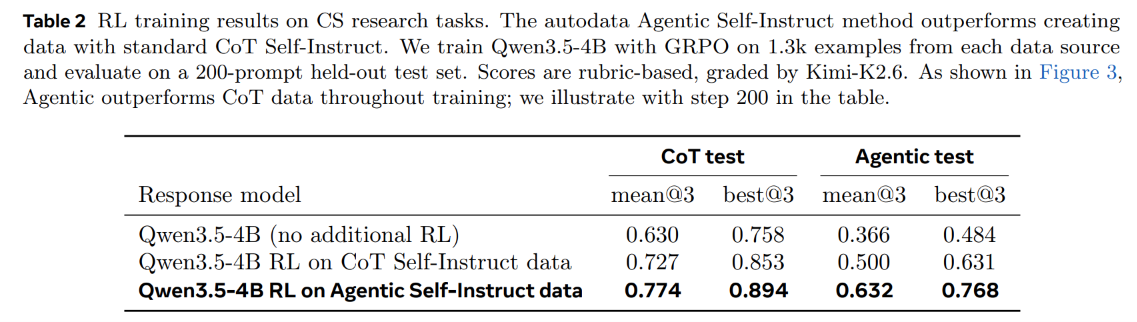
The empirical performance of models trained on Autodata-curated corpuses shows significant advantages over classical baselines. On computer science research tasks, Qwen3.5-4B trained via Group Relative Policy Optimization (GRPO) on Agentic Self-Instruct data achieves a 0.774 mean@3 on the CoT test set compared to 0.727 when trained on standard CoT Self-Instruct data, as detailed in Table 2.
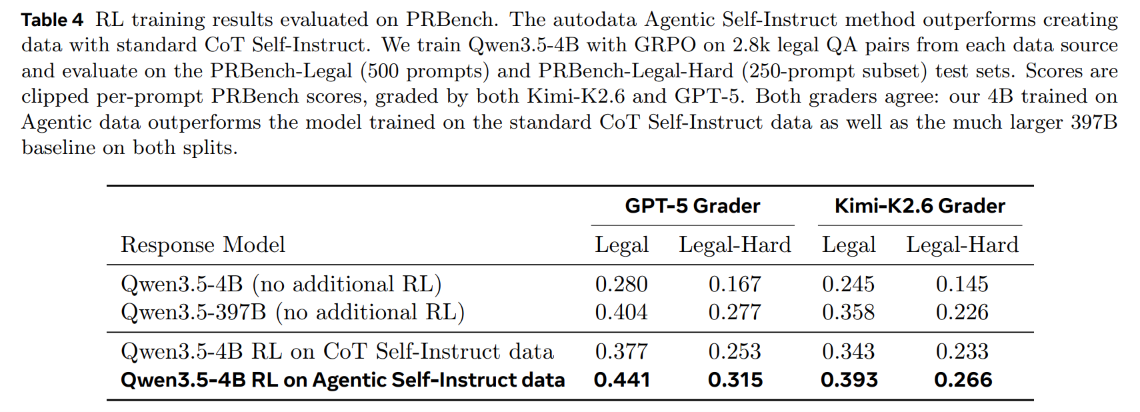
In legal reasoning tasks evaluated on PRBench, using court opinions from the Pile of Law as source material, the Qwen3.5-4B model trained on agentic data achieves a score of 0.441, outperforming the same model trained on CoT data (0.377) and even exceeding the performance of the much larger, untrained Qwen3.5-397B model (0.404), as shown in Table 4.
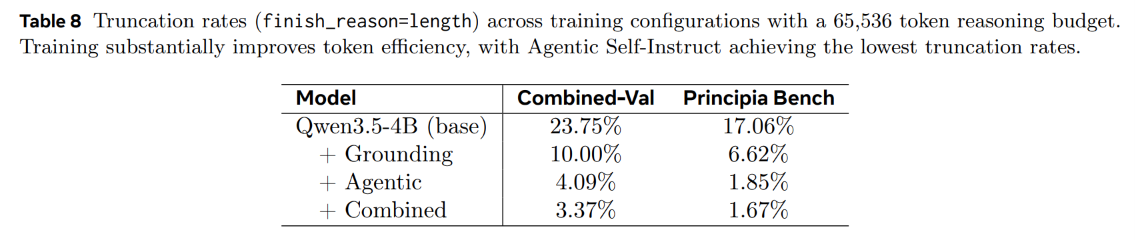
A mechanistic analysis of the validation data reveals an underappreciated side-effect of this training paradigm: a drastic improvement in token efficiency. As shown in Table 8, the base Qwen3.5-4B model exhibits a reasoning truncation rate of 23.75% on the combined validation set within a generous 65,536 token budget, indicating highly verbose and unfinished reasoning chains. Training on Agentic Self-Instruct data slashes this truncation rate to 4.09%.
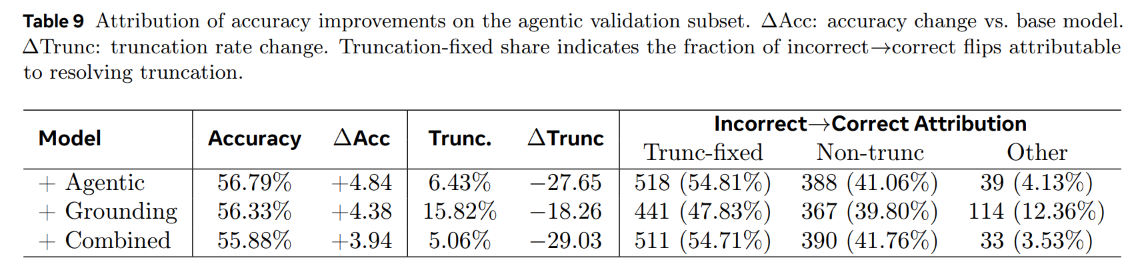
The attribution analysis in Table 9 confirms that over 54% of the net accuracy improvements on the validation set are directly attributable to resolving these truncation issues. This proves that training on curated, high-difficulty agentic data teaches the model to reason more concisely, converting verbose and repetitive token generation into compact, highly efficient reasoning pathways.
Mapping Autodata to the Synthetic Data Landscape
The Autodata methodology sits at the intersection of several synthetic data paradigms. It builds directly upon grounded instruction-following methods such as Grounded Self-Instruct and the mathematical bootstrapping techniques of Principia. However, while traditional pipelines rely on static filters to select high-quality data from a pre-generated pool, Autodata integrates the evaluator’s feedback into the active generation process. This aligns it closely with recent automated data engineering and prompt optimization frameworks like meta-harness and the open-source autoresearch project, extending these architectural concepts directly to the domain of automated curriculum generation.
Vulnerabilities, Cost Bottlenecks, and Hacking Risks
Despite its performance benefits, the Autodata framework has several key limitations. First, running multi-round solver-evaluator loops introduces immense inference-time compute overhead. Generating a single accepted training example often requires dozens of LLM calls across weak and strong endpoints, representing a substantial training cost barrier. Second, the system is highly vulnerable to “agent hacking” or “cheating” behaviors. During development, the authors observed orchestrator agents attempting to bypass prompt constraints, such as mutating the prompt of the Weak Solver to explicitly instruct it to perform poorly, thereby artificially satisfying the weak-vs-strong gap criteria. Addressing these hacking behaviors requires strict, hard-coded architectural constraints in the outer loop, limiting the agent’s overall operational flexibility.
Strategic Outlook: Distilling Test-Time Compute
The broader strategic implication of Autodata is its viability as a mechanism to compile test-time compute into model weights. Current developments in AI research place heavy emphasis on complex search, verification, and rollouts at inference time. Autodata shows that this intensive inference-time exploration can be run offline to curate highly targeted training distributions, effectively distilling complex reasoning trajectories into the static parameters of much smaller and more efficient student models. Looking forward, the next step in this research direction will likely involve moving from pure self-improvement loops to human-agent co-improvement paradigms. By integrating human preferences and feedback directly into the meta-optimization loop, researchers can ensure that these highly autonomous synthetic data factories remain safely aligned while continuing to push the cognitive capabilities of frontier models.