
Authors: Tim Genewein, Matija Franklin, Alexander Lerchner, Laurent Orseau, Samuel Albanie, Adam Bales, Cole Wyeth, Stephanie Chan, Iason Gabriel, Joel Z. Leibo, Allan Dafoe, Marcus Hutter, Thore Graepel, Shane Legg
Paper: https://arxiv.org/abs/2606.12683
Code: N/A
Model: N/A
TL;DR
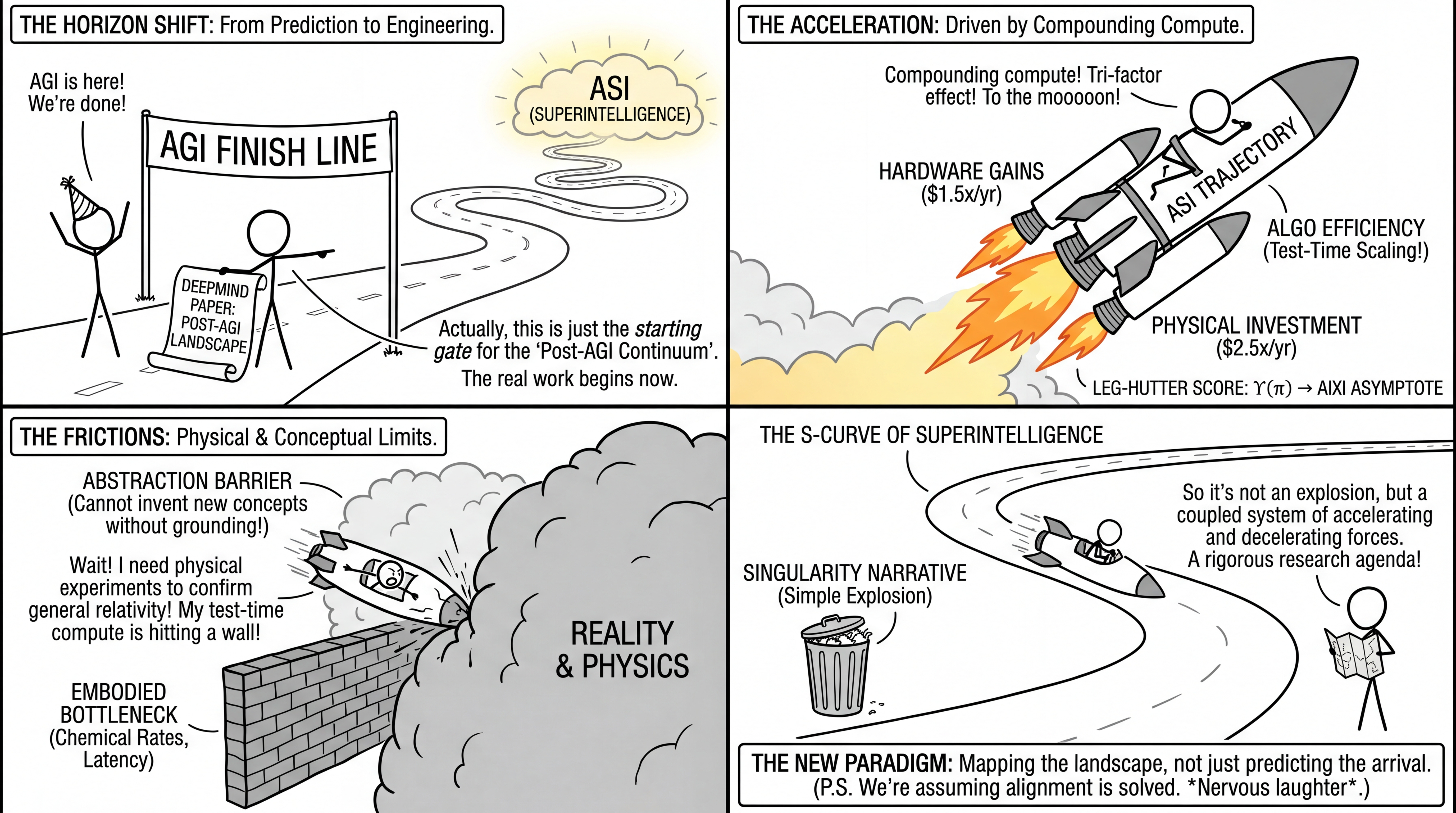
WHAT was done? Google DeepMind researchers present a formal conceptual framework and landscape analysis of the transition from human-level Artificial General Intelligence (AGI) to Artificial General Superintelligence (ASI), mapping four distinct technological pathways against six key structural bottlenecks.
WHY it matters? This work shifts the strategic horizon of the AI community from predicting the arrival of AGI to engineering the post-AGI continuum of machine intelligence. By grounding superintelligence in physical, theoretical, and economic constraints rather than unconstrained hyperbolic growth, it replaces speculative “singularity” narratives with a rigorous, actionable research agenda.
Details
The Horizon Beyond General Intelligence: Demarcating the Post-AGI Transition
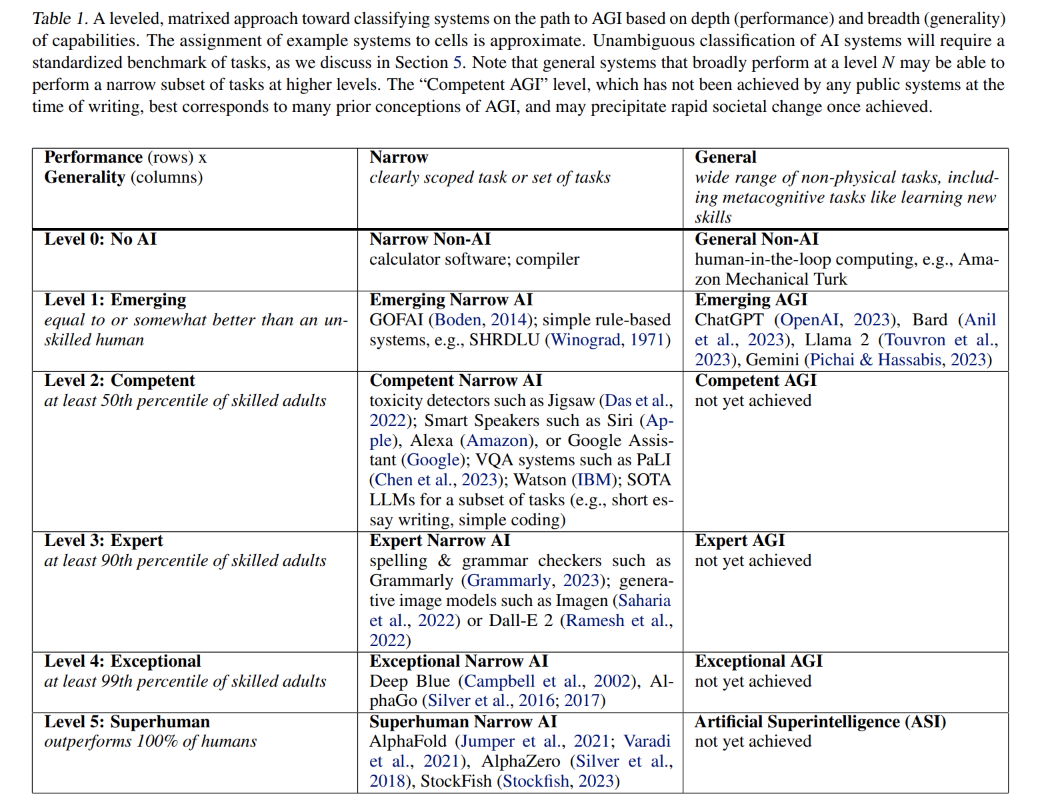
Over the past decade, the pursuit of human-level machine intelligence has transitioned from a speculative academic endeavor to a concrete, heavily capitalized engineering objective. While substantial research has analyzed the timeline and safety risks associated with reaching Artificial General Intelligence, comparatively little work has systematically mapped the landscape that lies beyond. This paper addresses this strategic gap by analyzing the continuum of machine intelligence from human-level AGI to Artificial General Superintelligence. Crucially, the authors depart from the baseline framework of Morris et al. (2024)—which categorizes levels of AGI up to individual human expert equivalence—by defining ASI as a system that regularly outperforms large, highly coordinated collectives of human experts across virtually all domains.
The transition to superintelligence is currently driven by a compounding growth rate in effective compute, which has historically expanded at approximately 10× per year. This expansion is powered by a tri-factor compounding effect: a 1.5× annual increase in compute-per-dollar via hardware manufacturing improvements, a 2.5× annual increase in physical compute investments, and a 3× to 6× annual improvement in algorithmic efficiency (see also this). However, the authors argue that simply extrapolating this exponential trend into an infinite “intelligence explosion” ignores the structural and physical boundaries of our world. To reduce this uncertainty, they suggest anchoring qualitative assessments in the formal limits of machine intelligence.
Formalizing Superintelligence: From Legg-Hutter Scores to AIXI Asymptotics
To ground capability trajectories in a rigorous theoretical substrate, the authors leverage the universal measure of intelligence formulated by Legg and Hutter (2007a). This mathematical framework formalizes intelligence as the expected cumulative reward achieved by an agent across all possible computable environments, weighted exponentially by their simplicity. The Legg-Hutter intelligence score, denoted as Υ(π) for an agent’s policy π, is formally defined as:
In this formulation, E represents the class of all computable, reward-generating environments, K(μ) is the Kolmogorov complexity of the environment μ, and Vμπ is the expected discounted cumulative reward achieved by policy π in environment μ, written as
with discount factor γ∈(0,1) and reward rt. The theoretical upper bound of this score is achieved by the incomputable AIXI agent, which utilizes Solomonoff Induction to update its posterior belief over all computable environment hypotheses in a Bayesian manner.
Solomonoff Induction acts as the optimal predictor by assigning an a priori probability to each environment according to the Universal Prior, meaning that simpler programs are exponentially favored. Although AIXI is incomputable and cannot be directly instantiated, it provides a formal asymptotic boundary. Real-world ASI, therefore, must be understood as an increasingly powerful computable approximation of this universal limit.
The Interlocking Dynamics of Capability Pathways and Structural Frictions
The transition from human-level AGI to ASI is mapped across four major technological pathways, which are not mutually exclusive and are highly likely to proceed in parallel, as shown in Table 3.
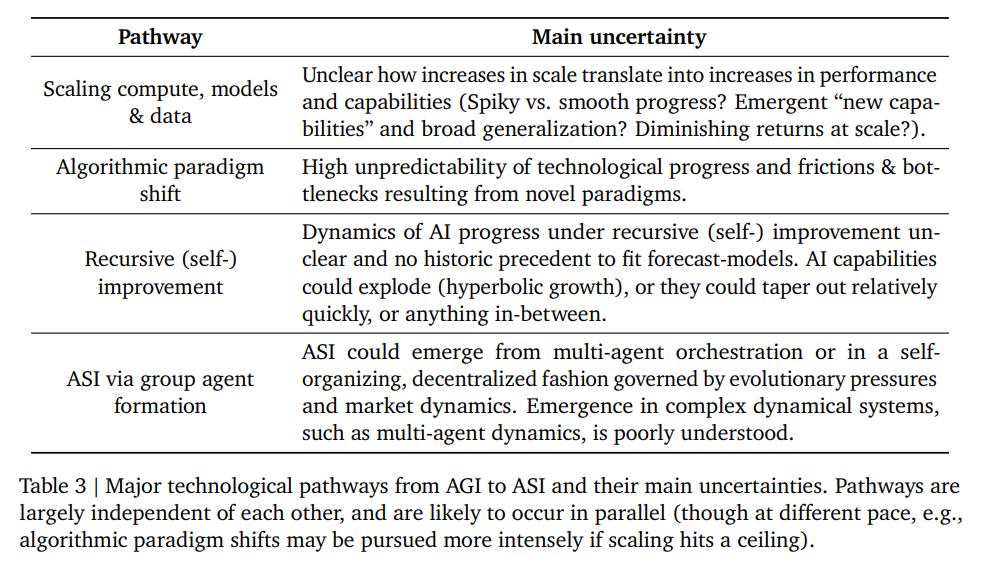
To understand how these pathways interact with the potential bottlenecks detailed in Table 4, consider a foundational thought experiment presented in the paper. Imagine a state-of-the-art transformer pre-trained on a dataset that contains a vast quantity of scientific tokens, but where the content is strictly restricted to pre-Newtonian, pre-industrial knowledge. Even if supplied with infinite quantitative compute and scaling, such a model would struggle to independently discover general relativity or quantum mechanics. This is because the system lacks a mechanism for “grounded concept discovery” to generate the conceptual primitives of calculus or electromagnetism from scratch.
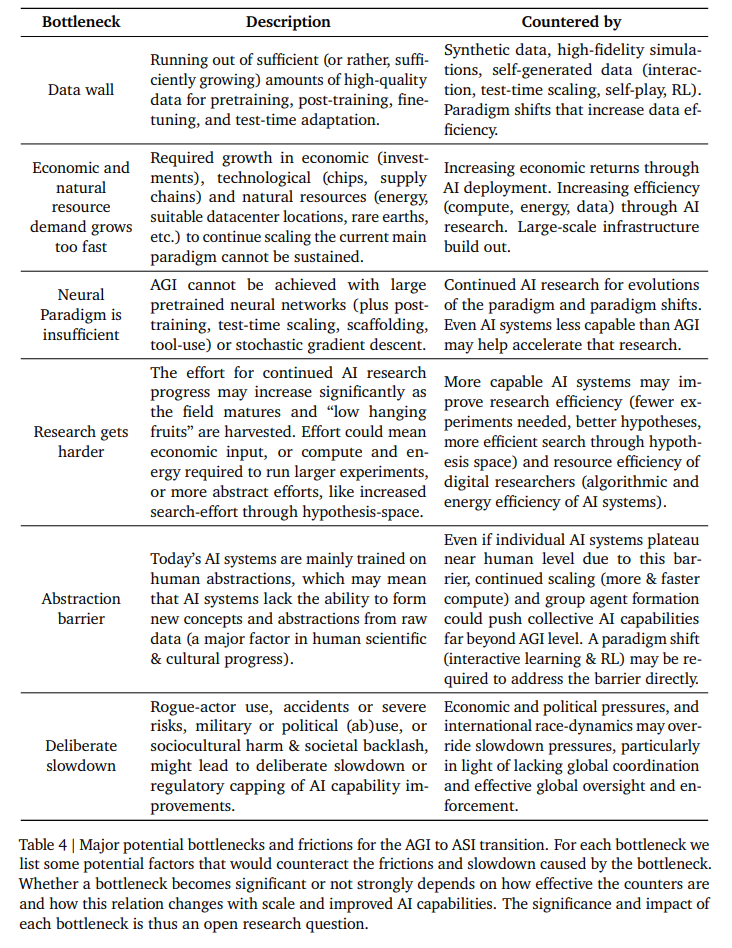
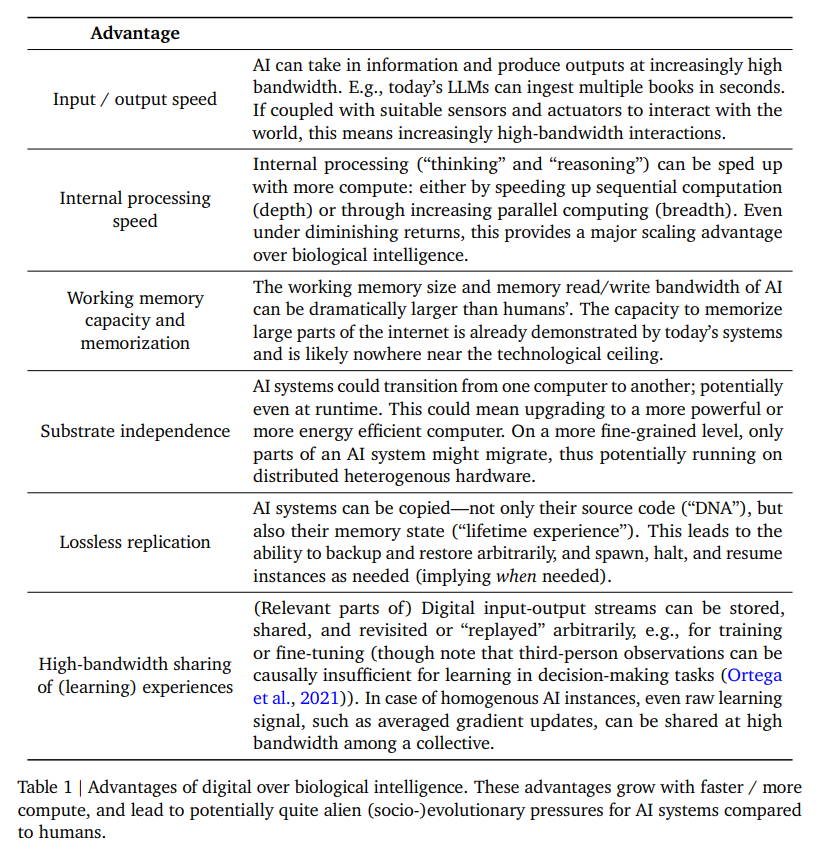
To break past this barrier, the machine must transition from the quantitative scaling pathway to the recursive self-improvement or multi-agent scaling pathways. For instance, the system could instantiate millions of specialized digital workers to execute a cognitive division of labor, as summarized in the advantages of digital intelligence in Table 1. These digital agents can replicate losslessly and communicate at high bandwidth, bypassing the low-bandwidth bottlenecks of human language. However, as these agents attempt to discover novel laws of physics, they immediately hit the “Embodied Bottleneck.” Because new conceptual primitives must be validated against physical reality to generate useful predictions, the speed of scientific progress becomes bound by the real-time latencies of physical experimentation, such as chemical reaction rates and physical material manipulation. Consequently, the rapid, purely computational intelligence explosion is bent into a physical, linear slowdown, demonstrating how theoretical pathways and physical frictions are tightly coupled.
Algorithmic Efficiency and the Physics of Compounding Compute
The engineering of modern frontier systems relies on approximating universal prediction through amortized Bayesian inference, where large parametric models minimize sequential log-loss over massive internet-scale datasets. However, as the industry approaches the “Data Wall,” continuing this trajectory requires a shift towards test-time scaling. This involves allocating additional computational budgets at inference time to enable structured search, planning, and chain-of-thought reasoning, effectively decoupling capability gains from static training datasets.
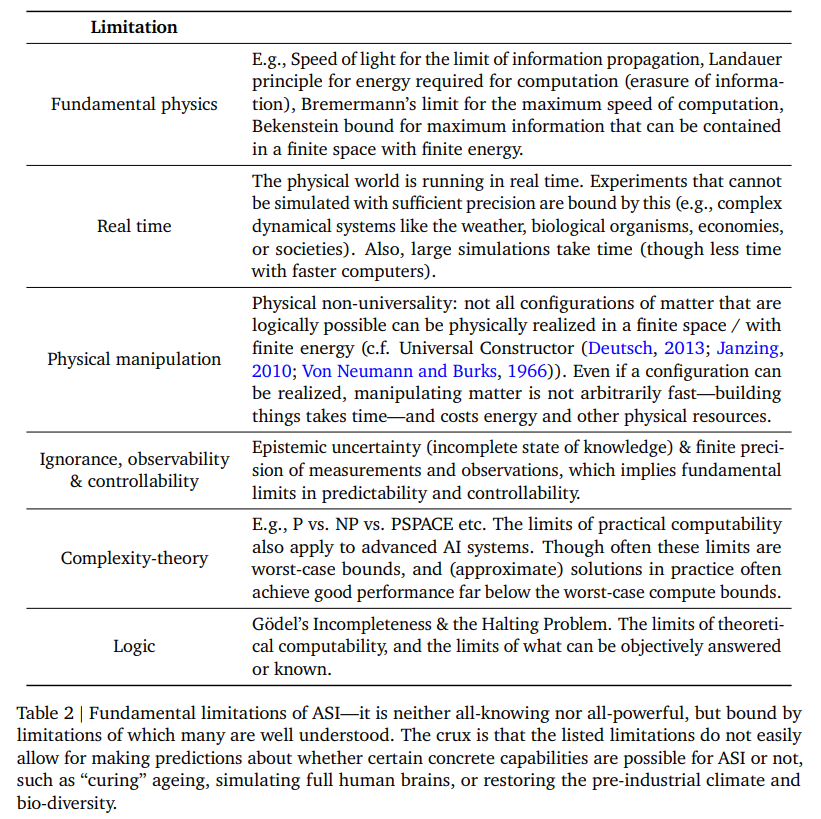
To mathematically sustain these advances, research must focus on optimizing the trade-offs between base model parameters and test-time compute. This is particularly relevant when attempting to run autonomous agents in parallel. While the physical limits outlined in Table 2 (such as Landauer’s principle for the minimum energy required to erase information, and the speed of light for information propagation) present hard boundaries in the limit, practical engineering is currently bottlenecked by memory bandwidth and chip interconnects. In the absence of novel hardware paradigms or neuromorphic computing architectures, the time spent moving data between memory units and compute nodes will continue to yield diminishing returns for monolithic model scaling.
Deconstructing the Ceilings: The Abstraction Barrier and the Embodied Bottleneck
A central contribution of this landscape report is the formal characterization of the “Abstraction Barrier” as a fundamental limit to pure scaling. Current foundation models excel at absorbing and recombining existing human-generated conceptual abstractions that have already been translated into symbolic language. They do not, however, possess a native mechanism to extract stable, novel conceptual primitives directly from raw, high-dimensional physical data. If superintelligence is to achieve “transformative creativity”—such as Margaret Boden’s third level of creativity, which involves constructing entirely new conceptual spaces—it must transcend human cognitive boundaries.
Proving whether current architectures can overcome this barrier requires rigorous mechanistic analysis and probing of latent state trajectories. When models are trained exclusively on self-generated synthetic data to bypass the data wall, they routinely suffer from model collapse and recursive degeneration, as shown in Gerstgrasser et al. (2024). This suggests that self-play and simulation are only effective when guided by high-fidelity verifiers or grounded interaction with an external physical environment. Without active, grounded interaction, the lack of real-world feedback loops severely limits the model’s capacity to build robust, causal world models.
Anchors in the Literature: Building on Sutton’s Bitter Lesson and Bostrom’s Convergence
The analytical framework developed by the authors directly synthesizes and extends several landmark theories in the AI literature. It builds upon Sutton (2019) (”The Bitter Lesson”) by confirming that general methods leveraging search and learning systematically outperform hand-crafted human heuristics, a principle that underpins both the scaling and recursive self-improvement pathways. Additionally, the paper integrates Nick Bostrom’s (2012) theory of instrumental convergence, analyzing how scale naturally incentivizes superintelligent agents to pursue universally useful sub-goals such as resource acquisition, self-preservation, and cognitive self-improvement.
To mitigate the catastrophic risks associated with these convergent drives, the authors connect their capability trajectories with the technical alignment literature, referencing formal corrigibility formulations by Soares et al. (2015) and safely interruptible agents by Orseau and Armstrong (2016). Furthermore, they contrast their transformative outlook with the “normal technology” paradigm of Narayanan and Kapoor (2025), illustrating that while individual models may experience plateaus, the emergence of coordinated digital collectives can still bypass individual architectural limitations.
Bracketing the Alignment Challenge: Speculative Foundations of Capability Projections
While the paper provides an exceptionally detailed taxonomy of capabilities, its methodology possesses a critical structural limitation. To focus purely on technological and physical trajectories, the authors explicitly assume as a working hypothesis that the AI safety and alignment problem will be solved to a sufficient degree in a post-AGI world. This is a highly optimistic assumption. In reality, alignment difficulties are highly likely to act as a direct, severe bottleneck to capability development itself, as unsafe, deceptive, or uncontrollable systems cannot be safely deployed or trusted with autonomous R&D pipelines.
Additionally, because the paper is a speculative foresight report rather than an empirical benchmarking study, its predictions are inherently subject to high parameter uncertainty. As capabilities exceed human expert performance, traditional evaluation benchmarks like GPQA or SWE-bench saturate rapidly, creating a measurement gap that makes it incredibly difficult to empirically validate when or if an AGI has transitioned into ASI territory.
Strategic Imperatives: Transitioning from Speculation to Rigorous Forecasting
Google DeepMind’s comprehensive blueprint serves as a vital call to action for the global research community to transition from speculative, sci-fi singularity debates to a rigorous, scientific agenda for forecasting machine intelligence. The transition from AGI to ASI is highly unlikely to be a single, sudden step-change. Instead, it will unfold as a coupled system of accelerating forces—such as digital replication advantages—and decelerating physical, economic, and sociopolitical frictions.
To prepare for this post-AGI continuum, AI labs and academic institutions must immediately prioritize several key research directions. These include the development of non-saturating, general-induction benchmarks based on algorithmic compression, the formulation of quantitative “multi-agent scaling laws” to understand how group intelligence scales with population size, and the design of robust, high-fidelity physical simulators to help systems cross the abstraction barrier. Navigating this high-velocity trajectory safely and effectively will require a deeply interdisciplinary, global effort to build the empirical and theoretical foundations of superintelligent capabilities long before they are physically manifested.
P.S. Just in case, if you are interested in the topics of AGI/ASI, there is a Superintelligence Conference (SiC26) this September, CFP is here!