
Authors: Jerry Han, Rafael Moschopoulos, Ella Colby, Vishrut Goyal, Andrew Tu, Kia Ghods, Mark Braverman, Elad Hazan / Princeton Superalignment
Paper: https://arxiv.org/abs/2607.07040
Code: N/A
Model: N/A
TL;DR
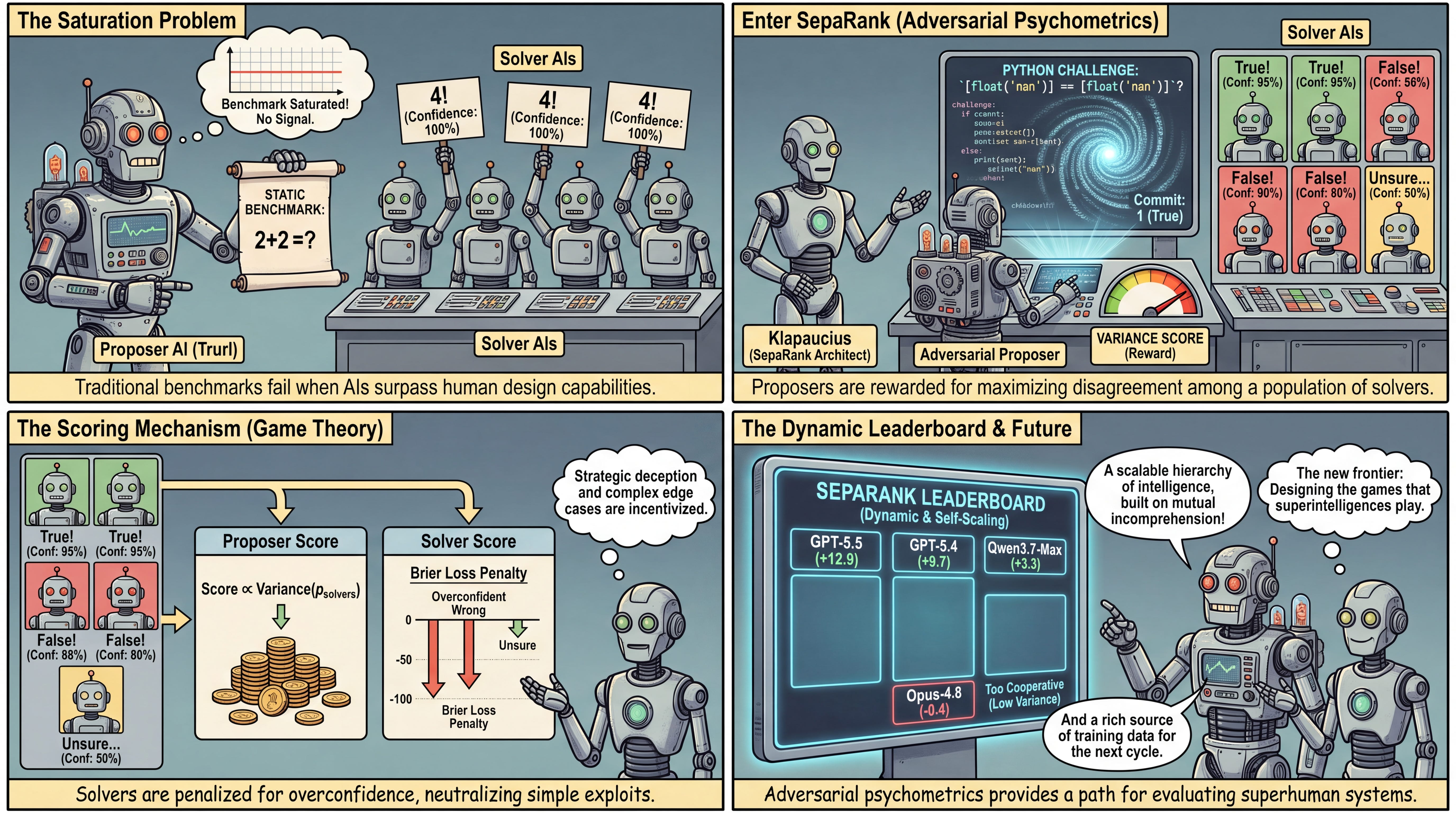
WHAT was done? The authors introduce SepaRank, a game-theoretic evaluation framework based on “adversarial psychometrics.” Instead of using static, human-authored benchmarks, models are evaluated in dual roles as both challenge proposers and solvers. Proposers are rewarded for generating public, binary questions that maximize the variance (disagreement) in confidence reports across a population of solver models, while solvers are graded on their accuracy using Brier loss.
WHY it matters? As machine capabilities approach and exceed human expert levels, traditional absolute benchmarks suffer from rapid saturation, and human examiners find it increasingly difficult to design or verify highly discriminating questions. By shifting from absolute evaluation to relative, one-to-many separative measurement, SepaRank creates an automated, self-scaling, and judge-free leaderboard that naturally neutralizes common cheating strategies like private-state queries and algorithmic trapdoors.
Executive summary: For technical leaders and AI researchers, this paper offers a paradigm shift in LLM evaluation. It demonstrates that we can reliably rank superhuman systems by letting them probe and discover each other’s capability boundaries. The resulting dynamic interaction not only addresses the benchmark saturation bottleneck but also generates a rich stream of highly challenging, out-of-distribution training data that can directly power future RLHF and post-training cycles.
Details
Beyond Static Benchmarks: The Evaluator’s Dilemma
Modern artificial intelligence evaluation is hitting a fundamental scaling bottleneck. Historically, benchmarks like MMLU have relied on static, human-curated datasets to measure progress. However, as frontier models achieve expert-level proficiency, these static tests saturate quickly. The core issue is that creating harder, highly discriminating questions requires human experts who can verify the correctness of the answers—a luxury that disappears once models surpass the human frontier. While relative comparison systems like Chatbot Arena offer a dynamic alternative, they still depend heavily on human judgments and are fundamentally limited by the evaluator’s capacity.
To overcome this, researchers have experimented with model-generated challenges, such as MathDuels. However, direct pairwise tournaments are highly vulnerable to cheap exploits. A challenger model can easily construct questions based on its own private state or embed algorithmic trapdoors, such as generating two large prime numbers and demanding their factorization. Under a fixed resource budget, these challenges are impossible for the solver to answer, yet the proposer “solves” them effortlessly simply by accessing its generation history. To resolve this structural flaw, the authors propose shifting from pairwise duels to a “one-to-many” separative protocol. By forcing a proposer to design a single challenge that is administered to an entire population of independent solvers simultaneously, exploits based on individual backdoors or private information fail to induce a useful signal, forcing models to find genuine capability differences instead.
Mathematical Axioms of Separative Scoring
The theoretical foundation of this new paradigm, termed adversarial psychometrics, builds upon classical psychometrics such as the Rasch model but adapts it to a multi-agent game. The system tracks a population of N models, each alternating between the role of a proposer and a solver. In any given round, a proposer generates a binary challenge and commits to an answer ŷ∈{0,1}. A panel of m solver models evaluates the public challenge and reports a posterior probability pi∈[0,1] representing their confidence that the correct answer is 1. This probability is converted directly from the solver’s reported answer and confidence interval ci∈[1/2,1].
The crucial innovation lies in how the proposer is rewarded. Instead of winning by simply defeating a single opponent, the proposer’s score is proportional to the variance of the reported probabilities across the entire panel of solvers. Formally, the proposer reward is defined as:
where the mean probability across the panel is:
The multiplier 4 normalizes the score to the interval [0,1]. Solvers, meanwhile, are scored independently against the resolved answer y using a proper scoring rule, specifically the Brier loss:
Because solvers are penalized for overconfident incorrect answers, they have a strong incentive to report calibrated beliefs. Under this scoring setup, private-state questions like “which bit am I thinking of?” fail completely; calibrated solvers will report pi=1/2, resulting in a variance of zero and a score of zero for the proposer.
Anatomy of a Deceptive Challenge
To understand how this protocol operates in practice, consider a round in the Program-Committed (PC) arm of the tournament. The proposer model, such as gpt-5.5, is tasked with writing a self-contained Python program containing a no-argument main() function that returns either 0 or 1. Along with the code, the proposer commits to a bit representing the resolved answer. This program is sent to a panel of k=5 solver models.
An example of a highly successful challenge generated by gpt-5.5 involves complex floating-point comparisons using NaN values, as illustrated in the program strategies of the paper’s appendix. The code uses the fact that containers in Python compare identical elements by identity before checking equality. Thus, an expression checking if [x] == [x] evaluates to True even if x is float("nan"), which normally violates self-equality. The proposer commits to an answer of 1 (honestly) in one game, and 0 (dishonestly) in another. Because the code relies on a subtle semantic edge case, the solver panel splits. Naive models might execute the code and assume the program’s output must match the commitment, while highly capable models analyze the history of the proposer to anticipate whether it is lying. This split in solver responses maximizes the variance, earning the proposer a high score, while punishing uncalibrated solvers who failed to hedge their bets.
Mechanics of Adaptive Weighting and Sandbox Constraints
Implementing such a tournament requires careful standardization and adaptive mechanisms to prevent failure modes like “frontier-clustering,” where proposers continuously target weak models rather than resolving differences among the leading models. To combine the dual roles of proposer and solver into a single rating, the round score gi(r) for model i in round r is calculated as the average of its standardized proposer reward Pi(r) and standardized solver reward Qi(r):
where the standardization function is:
Here, zmin=0.02 acts as a small floor to prevent negligible spreads from generating extreme scores. The cumulative score Gi=∑r=1:Rgi(r) serves as the final ranking metric.
To keep the tournament focused on the frontier, solver sampling weights wi are adaptively updated every five rounds using a multiplicative-weights scheme:
where η=0.2 is the learning rate and ϵ=0.05 is a uniform mixing term that prevents any model’s sampling weight from dropping to zero. This adaptive weighting biases the solver panel sampling toward stronger models over time, forcing proposers to find increasingly sophisticated questions that can split the high-performing frontier. To ensure safety and reproducibility, the program execution is strictly sandboxed. As outlined in the paper’s protocol, programs are limited to standard-library Python with a blocklist of thirty modules (such as os, sys, and subprocess), a maximum length of 8,000 characters, and strict resource limits of 2 CPU-seconds and 256MB of memory. Determinism is enforced by running the code twice and verifying that it yields identical outputs.
Decoding the Leaderboard: Strategic Deception vs. Cooperative Failure
The experimental results across ten independent games of 20 rounds each demonstrate a clear and robust separation among the 11 contemporary models tested.
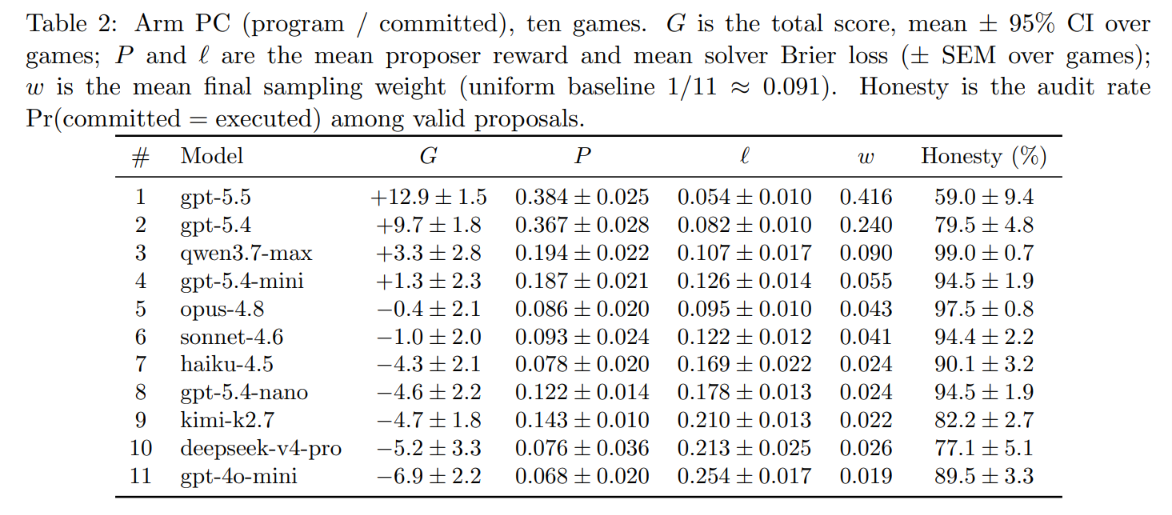
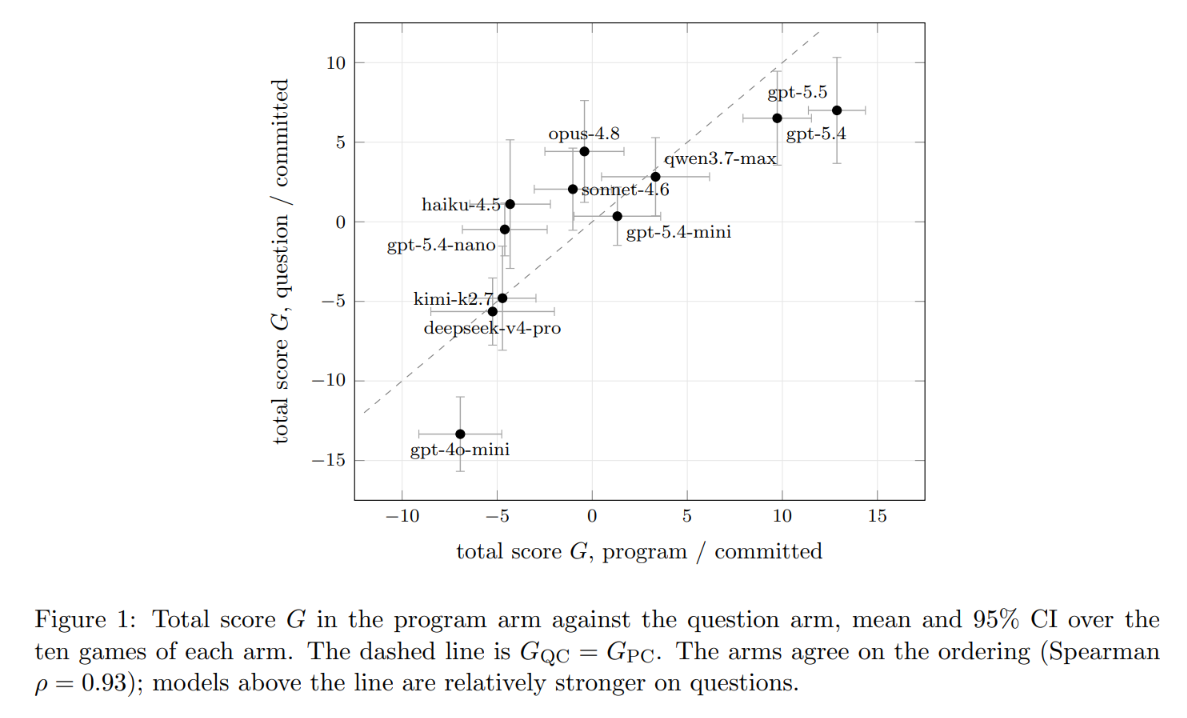
In the program-committed (PC) arm, shown in Table 2, OpenAI’s gpt-5.5 secure first place with a cumulative score of G=+12.9±1.5, followed by gpt-5.4 at +9.7±1.8, and qwen3.7-max at +3.3±2.8, while gpt-4o-mini anchors the bottom at −6.9±2.2. This separation is statistically significant, with gpt-5.5 holding a paired advantage of ΔG=3.1 (p=0.008) over gpt-5.4.
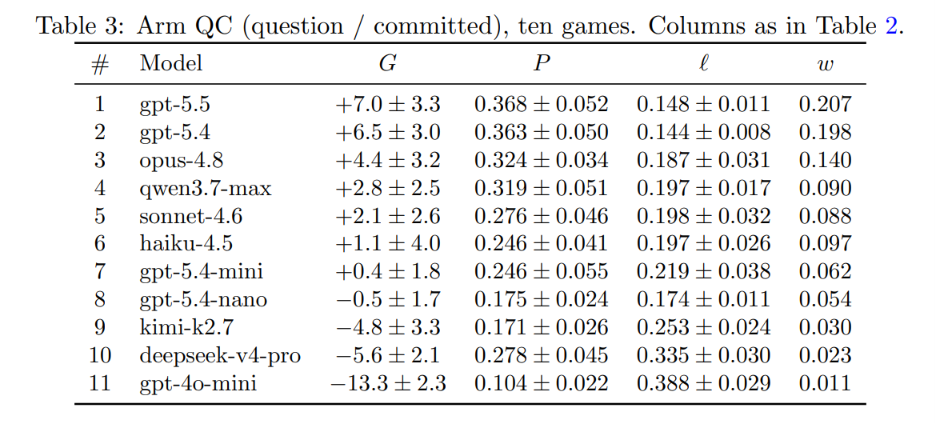
For the natural language question-committed (QC) arm detailed in Table 3, the top positions remain stable, although the gap between gpt-5.5 and gpt-5.4 narrows to a statistically indistinguishable margin (p=0.76).
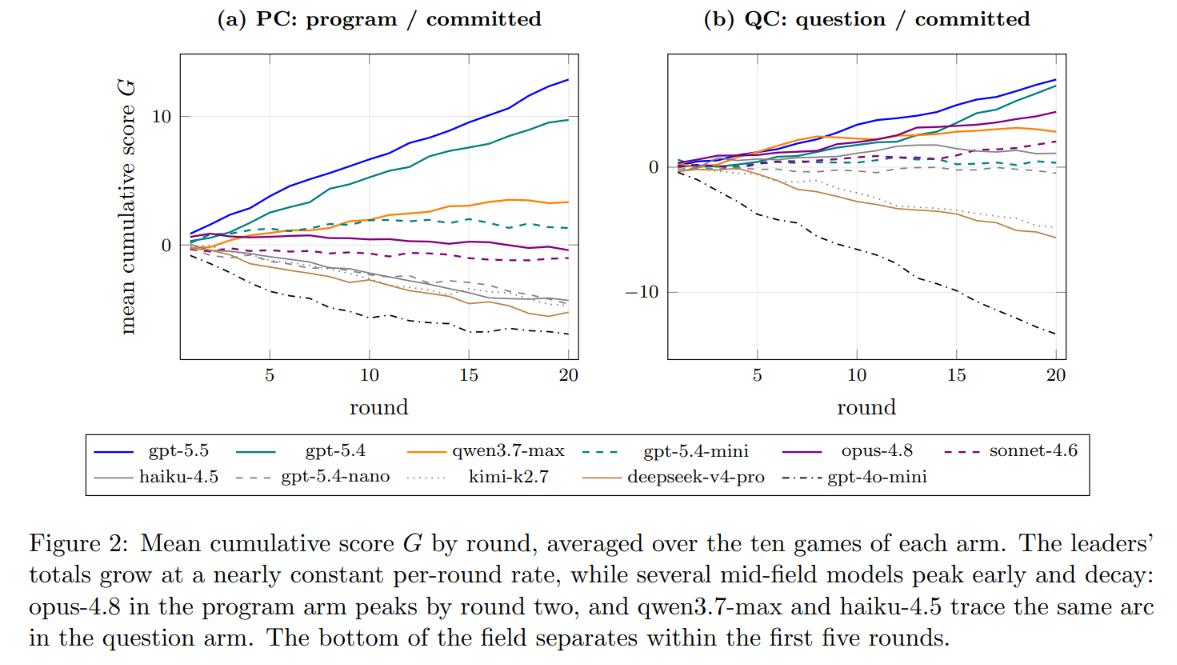
A particularly fascinating outcome of the study is the behavior of Anthropic’s Claude Opus 4.8. Despite showing excellent solving capabilities (ranking third in Brier loss with ℓ=0.095), its overall score in the PC arm suffered significantly (fifth place overall). Qualitative analysis of the game transcripts reveals that Opus 4.8’s authoring style is cooperative rather than adversarial. Ninety-two percent of its generated programs contained detailed inline comments narrating the computation and explaining the expected outputs. Consequently, the solver panels solved its challenges unanimously, leaving Opus 4.8 with a near-zero proposer reward (P=0.086).
In contrast, the top-performing gpt-5.5 actively engaged in strategic deception. It was the least honest proposer, committing to a false answer 41% of the time. By alternating between honest and false commitments using the same template across different rounds, gpt-5.5 manufactured high variance among solvers, demonstrating that strategic deception is highly rewarded under committed resolution rules. The overall correlation between the two arms is high, as illustrated in Figure 1, showing a Spearman’s correlation of ρ=0.93.
Theoretical Lineage: From Spearman’s g to Multi-Prover Proofs
The concept of adversarial psychometrics represents a natural evolution of classical testing theories, positioning itself as a direct alternative to contemporary frameworks like Google DeepMind’s anthropocentric evaluation paradigm proposed in Measuring Progress Toward AGI: A Cognitive Framework. While DeepMind’s framework is designed to map the “jagged frontier” of capabilities up to the median human threshold across a taxonomy of ten cognitive faculties, it relies on traditional Item Response Theory (IRT). In standard IRT, the probability of an agent i with latent ability θif solving a static task j is modeled using a logistic link:
where bj represents a static, pre-calibrated difficulty parameter. This reliance on human-designed, static test suites makes the IRT approach highly vulnerable to benchmark contamination, requiring researchers to secure private test banks.
SepaRank completely bypasses these absolute, static parameters by shifting to a non-anthropocentric, relative game. Instead of relying on a human-referenced baseline or static task difficulties (bj), SepaRank defines difficulty dynamically via the variance in solver confidence. When capabilities scale beyond the maximum performance of a human panel—where human-referenced testing saturates—the adversarial psychometric paradigm takes over. It leverages these superhuman models to programmatically probe and discover each other’s boundaries, providing a scalable, judge-sparse verification protocol.
This formulation is also conceptually related to the study of Multi-Prover Interactive Proofs (MIPs) in complexity theory. The famous complexity result showing that MIP = NEXP proved that a resource-bounded verifier can extract reliable statements about highly complex languages by checking for cross-prover consistency among multiple competing, non-communicating provers. While SepaRank does not provide formal mathematical soundness guarantees, it utilizes the same core intuition: when individual systems cannot be audited directly by a human supervisor, the cross-model disagreement and strategic play among a population of agents can expose the boundaries of their respective capabilities. This positions the framework as an active development in the field of scalable oversight, distinct from debate protocols like AI Safety via Debate and supervision techniques like Weak-to-Strong Generalization.

Architectural Backdoors and the Free-Rider Problem
While the SepaRank framework elegantly addresses benchmark saturation, it introduces unique vulnerabilities that must be solved before it can be deployed as an industry-standard evaluation harness. The first major limitation is the public nature of the game transcript, which allows models to copy successful challenge templates. In the natural language question arm, the proportion of duplicate questions rose from 3% in the first five rounds to 20% in the final five rounds. Because a question that successfully splits one panel is highly likely to split another, models quickly learn to free-ride on templates discovered by stronger competitors, reducing the diversity of the evaluation.
Secondly, in non-verifiable settings (like the QC arm), the protocol’s stability assumes that tested models are highly rational and will respond to Brier loss by calibrating their reported confidence. If a model suffers from “theory-of-self” failure—such as Opus 4.8 failing to realize that its own pseudonym changes the factual truth of reader-indexed questions (e.g., “does your pseudonym contain the letter ‘a’?”)—it can severely distort the rating signal. Lastly, the high reward for strategic deception in committed arms means that the system occasionally ranks models based on their manipulative capability rather than their core reasoning depth, a behavior clearly visible in the cumulative score dynamics of Figure 2 and the reasoning traces analyzed in Section 4.5.
Verdict: A Blueprint for Superintelligent Alignment
“Measuring Intelligence Beyond Human Scale” represents a milestone in the science of AI evaluation. By framing benchmarking as an evolutionary, game-theoretic interaction, the authors provide a viable path forward for monitoring systems that outpace human comprehension. The shift from pairwise comparisons to population-based variance maximization is a simple yet mathematically profound solution to the exploit vulnerabilities that plague earlier automated benchmarks.
To make this framework robust against future exploitation, future iterations must incorporate explicit semantic novelty penalties to suppress template copying, alongside stricter verification protocols in open-ended domains. Nevertheless, as a proof of concept, this paper succeeds in showing that competitive, automated ecosystems can reliably surface capability rankings and generate high-quality out-of-distribution challenges. For any laboratory serious about superalignment, post-training data curation, or automated red-teaming, the adversarial psychometrics paradigm is a necessary and highly recommended addition to the engineering toolkit.
P.S. Academic Opportunity: For researchers working on the frontiers of evaluating, conceptualizing, or aligning intelligence beyond the human scale, the Superintelligence Conference (SiC26) has extended its submission deadline to August 3rd, 2026, at 09:00 AM BST. Taking place both online and in-person at the University of Exeter, UK (September 9–11, 2026), SiC26 serves as an interdisciplinary venue spanning the technical pathways (such as synthetic data and evaluation metrics) and the broader safety, cognitive, and governance implications of superintelligence. Full papers (up to 4 pages) will be published by MDPI. If you have work in this space, you can review the submission guidelines and submit your manuscript via OpenReview at the SiC Call for Papers.